The future of manufacturing: Only the innovative need apply

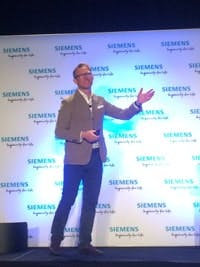
“The global economy is growing at the same rate it was in the Dark Ages, the 1300s. For the first time in centuries, we have to tell our children they may not have a better life than their parents," said Alastair Orchard, vice president, Digital Enterprise at Siemens.
“Detroit, we have a problem. The rampant growth the global economy has been experiencing is fading away,” warned Alastair Orchard, vice president, Digital Enterprise, Siemens. “The global economy is growing at the same rate it was in the Dark Ages, the 1300s. For the first time in centuries, we have to tell our children they may not have a better life than their parents.” Orchard was one of several presenters who spoke at the Manufacturing in America Summit, sponsored by Siemens and Electro-Matic, which more than 2,000 people attended at General Motors’ Renaissance Center in Detroit.
Historically, growth has always been driven by revolutions in manufacturing. First it was by steam. Second was by electricity, and the third industrial revolution was by automated mass production. “Each represented a huge leap forward,” said Orchard. “If you want to grow, you have to produce more. We’ve sent manufacturing off-shore, chasing low-cost labor from country to country. Low-cost labor eventually becomes high-cost labor.” Orchard explained how industry has focused on relocating manufacturing facilities to emerging countries with lower costs of living. Over time, wages rise in those countries, and corporations have to move operations again to find lower-cost labor.
The digital enterprise is about proximity to consumers, no longer off-shoring or building mega factories, said Orchard.
ALSO READ: Evolution finds a way with machine builders
“We’ve been producing things the same way for 50 years, so now we’ve turned to the tech sector,” said Orchard. “We’ve failed to increase productivity because we haven’t reinvented manufacturing. Now, the same Moore’s Law that’s put a computer in your child’s Xbox has changed manufacturing. The cost of key technologies has been dropping. Speed has improved, cost has dropped, and production has increased.”
Much of the reason for shorter time to market, higher profitability and more product has been the introduction of digitalization, and more specifically the digital twin. “When we talk about the digital twin, we’re not just talking about the product,” explained Orchard. “Siemens has extended the digital twin throughout the entire value chain. We’ve created a digital enterprise. You can identify problems in the design and problems in manufacturing. Bottlenecks can be improved without ever committing a physical resource.”
Siemens runs months of production in a digital simulation to look for electrical, software and automation. “We can actually generate the automation code the machine will need,” explained Orchard. “We can revolutionize the way we do commissioning. We make sure it works. We can train operators in the virtual world. We take that manufacturing blueprint and hand it over to the MES to coordinate all of that to make sure the plant behaves and the product is made right the first time. We can provide native access to the digital twin.”
Siemens already has attempted this in 320 plants. Siemens’ electronics factory in Amberg, Germany, makes 1 million products per month. “That’s one every second, and products are delivered within 24 hours,” explained Orchard. “Since we’ve digitized, we’ve reduced 200 defects/million to just 10. Amberg had 1,200 people working when we started. And we still have 1,200 people working, but production has increased ninefold.”
Siemens’ success has come from innovation. Complacency is the enemy of innovation, but how does a company learn to innovate? “Innovation is an overwhelming word, and we often think it doesn’t apply to us,” said Josh Linkner, author of Hacking Innovation. “Like so many companies, Ringling Bros. and Barnum & Bailey became intoxicated with their own success, and now they’re out of business. Cirque du Soleil took a new approach, and now they perform for sold-out crowds throughout the world. Cirque du Soleil is valued at $2 billion and growing.”
Augmented reality, the Internet of Things, 3D printing, robotics, sensors and automation are all converging and creating a storm of change. “We can no longer rely on the rules of the past,” said Linkner. “The rules of the game have fundamentally changed. The one thing that can’t be outsourced or automated is human creativity.”
Linkner offered five big ideas that are obsessions to innovators.
1. Get curious. “The more curious we are, the more creative we become,” explained Linkner. “We’re very good at pattern recognition. Any time you’re about to make a decision instinctively, pause and ask, ‘Why not? What if?’” Linkner told the story of Jessica O. Matthews, a Nigerian woman who is a Harvard graduate. She’s also the CEO of Uncharted Play and the inventor of the Soccket soccer ball, which harvests energy from the athletes kicking the balls and can use that energy to run a light bulb for up to eight hours.
2. Crave what’s next. “Letting go is harder to do when you’re having success,” warned Linkner. “Too often, we overestimate the risk of trying something new, but we underestimate the risk of standing still. What if we apply planned obsolescence to our daily work? When you’re stuck on a problem, look for a borrowed idea. We can get great inspiration by borrowing from a company that’s outside our viewpoint.”
3. Defy tradition. There are many traditions that can and should be upheld, said Linkner. “But traditions in our professional lives can be deadly,” he cautioned. “Let’s look that tradition squarely in the eye and defy it. Don’t change for the sake of change, but challenge it. Make a list and see what would happen if you flipped it upside-down and did the opposite. You might find ones that work.”
4. Get scrappy. “We think of innovation as an equation that’s tied to our balance sheet,” explained Linkner. “The real DNA of innovation is grit—drawing on internal resources and doing more with less. Throw your imagination and creativity at those big problems.”
5. Adapt fast. “The myth of innovation is that a single lightning bolt of inspiration followed by mindless execution is how things happen,” warned Linkner. “Take the weight of the world off of your shoulders. Micro-innovations can turn into great results. It’s more about the speed at which you respond.” Linkner shared the entrepreneurial story of Tom Lix, founder of Cleveland Whiskey, a premium distillery that has changed the rules of the whiskey industry with its pressurized technology that reduces the aging process from 10 years to a few days.

Mike Bacidore is the editor in chief for Control Design magazine. He is an award-winning columnist, earning a Gold Regional Award and a Silver National Award from the American Society of Business Publication Editors. Email him at [email protected].
About the Author
 Mike Bacidore
Mike Bacidore
Editor in Chief
Mike Bacidore is chief editor of Control Design and has been an integral part of the Endeavor Business Media editorial team since 2007. Previously, he was editorial director at Hughes Communications and a portfolio manager of the human resources and labor law areas at Wolters Kluwer. Bacidore holds a BA from the University of Illinois and an MBA from Lake Forest Graduate School of Management. He is an award-winning columnist, earning multiple regional and national awards from the American Society of Business Publication Editors. He may be reached at [email protected]
 Leaders Logo
Leaders relevant to this article: