The drive to servo-centric packaging machines


MOST PHARMACEUTICAL manufacturers keep quiet about their new equipment purchases, and they usually expect their machine suppliers to do the same. What we do know is that servo-powered packaging systems are claiming space on those factory floors. These flexible machines have become a mainstay among consumer products companies. However, regulatory requirements still present formidable barriers to their use in the pharmaceuticals sector.
“The pharmaceutical industry is just realizing the benefits of servo technology—the easy changeovers that make it economical to do short runs and small lots,” says Jeff Jackson, product management director at Bosch Packaging Technology pharmaceutical division in Minneapolis, which has built many servo-driven machines for drugmakers. “Instead of taking several hours to change cams and mechanical machine setups, you simply recall a predetermined recipe for the machine, load up a different type or size of vial, and get back up and running in minutes.”
The perceived problem for drug manufacturers is that servo systems typically rely on PC-based control systems. They present many more validation issues than the PLC controls and mechanical linkages of conventional shaft-driven packaging systems.
Despite these apparent drawbacks, many pharmaceutical firms are willing to do what’s needed to put servo-centric machines on the floor, especially as they commercialize more specialty drugs with varied packing options. “With cost pressures from competitors, insurers, and large buyers, pharma companies are looking for machines that give them more flexibility,” adds Jackson. “An electronic system can do this far better than a mechanical system. Pharmaceutical companies are more open now to accepting and implementing servo technology in place of the mechanical solutions of the past because they know servos can give them this greater flexibility, which they need to meet varied production requirements.”
Servos’ Advantages
Economic pressures aside, an OEM who builds servo-based equipment gives users advantages over shaft-driven equipment, says Mike Wagner, business development manager at Rockwell Automation. “Before servos, packaging machines had an AC motor running at a fixed speed,” he says. “Mechanical linkages off the main shaft translated shaft motion from one speed to another or from rotational to linear motion. For each revolution of the main shaft, you had one product coming out the other end. Every time you wanted to go from vials to bottles or change the size or shape of the package, you had to reconstruct the machine.”
Servos change this game. Instead of mechanical linkages to a main shaft, each servo system, which includes motor, gearhead and software, operates independently.
“Everything—pressure, velocity, position—can be modified,” says Wagner. “Before, it would take seven hours to make those changes, so you didn’t want to do it unless you had a large enough lot to run effectively. Now you can make the changeover in three to five minutes. It’s like loading a recipe.”
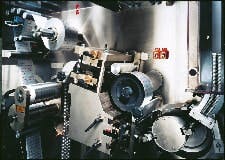
The pharmaceutical industry is beginning to see the benefits of servo-centric machines, particularly the easy changeovers that make it economical to do short runs and small lots. Bosch Packaging Technology has built many servo-driven machines for drug makers.
Freeing the servo-based functions from the drive shaft lets the machine controls adjust independently to each event during the packaging process. “Imagine a simple, low-to-moderate-speed bottling line,” says Bob Hartwig, vice president of Pester USA, an Allendale, N.J.-based subsidiary of a German packaging equipment firm. “It’s made up of a host of simple machines, all of them interdependent, and working in concert. As the system collects data, the servos on the line can adjust independently to any production problem as it occurs.”
Servos simply offer an entirely new level of speed and precision, adds John Kowal, global marketing manager for Elau Inc., a subsidiary of Schneider Electric. He says a conservative estimate is that 70-80% of the stretch banders, overwrappers, case packers and palletizers now sold to pharmaceutical companies already use servos.
“One of the great things about servo control is its closed-loop feedback,” he says. “Our servo-based capper controls torque to ±0.02% versus 20% for a standard clutch-drive capper. We know exactly what the values are. We can store the torque value for each cap, so if there’s a recall, the manufacturer might only have to recall a thousand bottles instead of a million bottles.” The same data can be analyzed for trends that indicate wear or a need for maintenance.
Also, since servos consist of much smaller motors, maintenance is rare. “Servos have a mean time between failures (MTBF) of 200,000 hours,” contends Wagner.
21st Century Manufacturing
Beside their technical advantages, servos are more affordable than in the past, which is breaking down another barrier to their adoption. “Five or six years ago, servos cost about $10,000 a pop,” says Hartwig. “Nowadays, they cost less than $5,000 each, and prices are still falling.”
Even at around $5,000 each, adding 10 servos would increase the price of an inexpensive $100,000 machine by 50%, so it might not always be an affordable answer. However, add those same 10 servos to a larger unit costing $500,000 to $1 million, and the cost hardly is a deal breaker. The payoff for users can be huge because they gain a large, fast line that’s flexible enough to package solids and liquids in a variety of containers in short and long production runs.
“They’re faster, more accurate, easier to control, easier to maintain, easier to implement, and longer lasting,” says a project manager at a leading pharmaceutical manufacturer, who declined to be identified. He says his company installs all-servo packaging lines when old systems wear out, and when it builds new plants. “We’re in the 21st Century, and this is a new way to run plants,” he says. “Servos help us predict problems before they occur. They tell us where to troubleshoot. Everything about them is easier. They’re a big step above driveshaft machines.”
Blue Screen Blues
That’s the good news. And, if it were the only news, then every pharmaceutical company would be using servos. That’s not yet the case, however, and the reason has to do with system controls.
To understand why servos might make the hair stand up on the back of a manufacturing engineer’s neck, look at the old-fashioned, drive-shaft packaging lines. They might not be flexible or precise, but their mechanical linkages make them very predictable. A PLC using ladder logic engages one function after another. It’s also a system that’s relatively easy to validate.
Meanwhile, servos are independently operated modules that depend on software instructions rather than gears, chains, and cams to execute their operations. Many of them use PC-based processors. This is both a strength and a weakness. On one hand, PCs make drag-and-drop programming and touchscreen control possible. They support sophisticated data gathering, transmission, and analysis, as well as integration of 21 CFR Part 11-compliant audit trails.
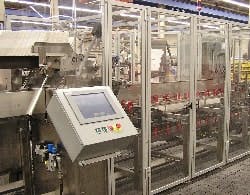
On the other hand, these characteristics are a PC-based system’s main weakness in the eyes of some machine builders, at least in the pharmaceutical sector. “PCs aren’t like PLC ladder logic,” explains Rusty Sparling, R.A. Jones & Co.’s sales director. “PCs can do 10 different things at the same time, so it’s a challenge to validate a machine when all those functions are going on simultaneously.”
Sparling adds that a pharmaceutical machine has to operate the same way every single time. “Instead of three paths, there can be only one path to an outcome, and it always has to be the same path,” he says. “The concern with a PC system is that if one thing goes wrong, the PC will find another path around it.”
Memories of the feared “blue screen of death” on desktop computers still can haunt manufacturers, says Darren Elliott, R.A. Jones’ chief electrical engineer, referring to a frozen PC. “They’re afraid of that occurring in their repeatable process.”
Reliability Realized
As a result, some pharmaceutical packagers insist that their machine builders provide PLC-operated servo systems. In essence, they dumb down their machinery to keep it from acting up. The PC is there, but it’s segregated, and used only for 21 CFR Part 11 security and data logging. Meanwhile, the PLCs run the machine. This might improve reliability, but it also eliminates many of the advantages of moving to servos in the first place.
And yet, there are other ways to ensure reliability. The key lies in helping users understand how to take control of the PC processor before Windows can get to it. This is possible when you start a computer and the system initializes itself, which is before it releases control of the processor to an operating system such as Windows. Then Windows boots up and allocates processor time to different applications, such as Word or Outlook.
For example, in a computer-controlled packaging line, after initialization is done, the control architecture grabs 100% control of the processor before Windows gets there. It then delegates processor time to Windows. This allows users to run Windows applications, but it’s the control architecture that’s in charge. If Windows dies, the packaging line keeps running. You might have to switch to manual control because the HMI is gone, but you’re still running.
However, even this strategy can seem risky to some manufacturers. They might opt for a combination of PC and PLC controls by using the HMI to switch PLCs on and off. Many systems use a servo motion controller that slides into a PC slot. The PC software sends commands to a servo controller that controls the PLCs. The servos are subservient to the PLC, which is executing the process. The servos then send any feedback on the process back through the PLC.
Some companies are attracted to hybrid systems. They like the simplified operation and data collection, as well as the repeatability that comes with servos. Separating the PLCs from the HMI also reduces the likelihood of mistakes affecting the validated packaging process.
Others don’t want to deal with the headaches of PC-based systems. They just want to know it will keep running. They worry about stability. If they buy a PC to run the machine’s front end, they’re cognizant of PC shelf life, and want to make sure they can buy a PC part.
Still others worry about their ability to support the new technology, and the staffing and training issues that a switch might pose. “The corporate staff might want all-servo machines, but the customer’s plant personnel often can’t support it,” says Elliott. “Plants traditionally have a mechanically oriented maintenance staff. It takes an entirely different skill set to support software-drive servos.”
Jackson compares this present transition to moving from carburetor to fuel-injected engines in automobiles. “You used to be able to open the hood and fix it, but that’s not an option any more,” he says. “Skill sets needed for this equipment are completely different. Instead of looking for something that’s loose, you might have to diagnose a malfunctioning sensor.”
Standards on the Horizon
Ultimately, the transition to servos will be eased by the push for packaging system standards. Over the past year or two, the Open Modular Architecture Controls (OMAC) Users Group’s Packaging Machinery Working Group has teamed with the World Batch Forum (WBF) and ISA to accelerate its vision of plug-and-play packaging modules.
Recently assimilated into ISA, OMAC’s main goal is to standardize how packaging line software and hardware communicate with each other. Devices such as servos that adhere to these standards would work when attached to any OMAC-compliant packaging line, in much the way a graphics card or modem works when attached to a PC.
Consequently, it would be the machine builders that validate the servo, not the drug maker. Once validated, though, drug makers wouldn’t have to go through the laborious effort of revalidating each servo. Instead, they would build a system from OMAC-compliant modular components, and then validate the final packaging line.
The result of this would be an open, flexible packaging system that could be reprogrammed to work with a variety of drugs and containers. It could also be rebuilt to perform entirely different tasks.
Given the competitive forces pressuring the industry, lower costs and greater flexibility are no longer options. Even validation concerns aren’t likely to slow the move to servos.
WEB POLL: