Creating the missing layer: Why orchestration is essential for industrial AI success
Key Highlights
- The primary barrier to scaling AI in manufacturing is a lack of trust and governance, which requires an orchestration layer to bridge the gap between non-deterministic AI insights and the deterministic requirements of the factory floor.
- Manufacturers are facing an unprecedented perfect storm of pressures, including surging energy costs from AI compute demand, a projected 7.9 million job vacancies by 2030 and a rapid erosion of technical skills.
- To succeed, companies must build a foundation using digital threads and simulation to connect design intent to operational reality, ensuring AI decisions are validated against physical constraints before they are ever executed.
 CHRIS STEVENS and ANNEMARIE BREU
CHRIS STEVENS and ANNEMARIE BREU
SIEMENS
Keynote
Siemens’ Annemarie Breu and Chris Stevens will give a keynot presentation, “The Automation Impact: AI, Automation, and the Human Element,” at 9 am on June 23 during A3's Automate 2026 in Chicago.
For decades, manufacturing has relied on deterministic automation and incremental improvement. Rising global competition, productivity pressure and a shrinking technical workforce have fundamentally changed that model. Manufacturers can no longer bolt AI onto existing systems and expect transformation. Without context, guardrails and orchestration, AI adds risk instead of value. This keynote explores the automation impact, a shift toward integrating industrial AI with proven automation to build more resilient, adaptive operations. Drawing on real-world examples, it examines how manufacturers can move from being data-rich but insight-poor to creating a connected digital thread that turns insight into action. The session also highlights why workforce enablement is essential to scaling AI responsibly.
Every conversation about AI’s role in manufacturing is dominated by the promise of smarter automation, a better prepared workforce and real-time adaptation. Yet a gap remains: trust.
When an AI makes a recommendation, a system generates an action, and, often between the algorithm and the assembly line, there is a breakdown because of the lack of guardrails, context and chain of accountability connecting insight to execution.
Deploying automation has always required confidence that the system will do what it's supposed to do, but introducing AI into that equation raises the stakes considerably. Bridging that gap requires an orchestration layer that closes the loop between AI-generated insight and action on the floor in a way that manufacturers can depend on.
Pressures are coming from every direction
The environment manufacturers are operating in right now is unprecedented. The pressures are real, and they're arriving all at once.
- Energy costs: AI-driven compute demand is straining grid infrastructure , according to the Energy and AI report from the International Energy Agency (IEA).
- Workforce constraints: Reshoring is accelerating faster than the workforce to support it, with a projected 7.9 million vacancies projected by 2030, according to Korn Ferry's Global Talent Crunch study.
- Skills erosion: The half-life of manufacturing skills has dropped from seven years to under three, according to the 2018 Deloitte and The Manufacturing Institute skills gap and future of work study.
Paradoxically, the very technology creating much of this pressure is also the most powerful tool to solve it. These energy demands, the workforce gap and the complexity of production environments are all problems that require intelligence, which stresses the importance of getting AI implementation right the first time.
But getting it right starts with the right foundation.
Digital threads are the key to continuity
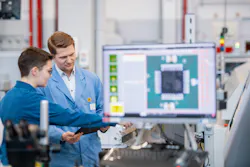
The foundation of any trustworthy AI is continuity. This is where the digital-thread approach is key. Digital threads provide this by connecting engineering to execution, design intent to operational reality and upstream decisions to downstream constraints (Figure 1).

All organizations have data, but it too often lacks context. We’ve seen AI pilots die in silos because their insights are fragmented. An insight generated in one system doesn't survive contact with the constraints that live in another, decisions get made without context, and context gets lost between handoffs, impacting decision making. Digital threads ensure information flows across the lifecycle, enabling AI to operate with intelligence rather than pattern-matching against incomplete inputs.
Making AI industrial-grade with an orchestration layer
There is immense pressure to deploy AI fast or risk falling behind, However, in manufacturing, where a flawed decision can stop a line, waste resources or create safety risks, governance is as important as intelligence.
We need an orchestration layer—a connective tissue between AI and physical production that makes intelligent decisions trustworthy enough to act on.
For decades, supervisory control and data acquisition (SCADA) systems have acquired data from physical processes to make control decisions and write actions back into the plant safely and deterministically. That determinism is precisely the point. Manufacturers need to know what their systems will do, and they need to know it with certainty.
AI is not deterministic, and that is not a flaw so much as a feature in many contexts. But in a high-stakes production environment where decisions affect safety, quality, energy consumption and uptime, variability without governance is a risk that most manufacturers cannot afford.
Get your subscription to Control Design’s daily newsletter.
This is why orchestration is critical. An orchestration layer doesn't replace SCADA or manufacturing execution system (MES) or enterprise resource planning (ERP); it works across all of them, coordinating decisions in a way that accounts for real constraints including energy costs, material availability and operational risk and validates actions against these constraints, all while ensuring decisions are traceable and explainable after the fact.
The value of simulation
Just as you simulate before commissioning a line or validating a control strategy, the same discipline applies to AI. We need to test AI before it’s implemented in a live production environment. Simulation enables AI to test decisions, understand second-order effects and build confidence before anything touches the physical world. It is where assumptions are validated against physical reality, where changes are explored before they are deployed and where trust is earned before autonomy is introduced.
This is the result of combining the real and digital worlds to drive measurable results.
The blueprint: Fort Worth
Digitalizing an enterprise connects the real factory with its digital twin to design, simulate and optimize the perfect production layout before anything is built (Figure 2). We’ve applied the same approach in our own factories, using our experience as a real-world proof point.
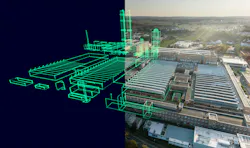
Last year, we opened an electrical manufacturing facility in Fort Worth, Texas, to support the infrastructure powering the data center expansion underway across the country. Faced with timeline and workforce pressures, we used simulation to define the plant’s layout and operational logic before the equipment arrived. SCADA became the backbone not simply for visibility but for coordination, surfacing signals with context, triggering actions within defined boundaries and keeping decisions governed.
We also transformed the workforce in the process. We started a program to train teachers, former chefs and delivery drivers that gave them the skills to switch careers to production. As a result, the facility has reached a retention rate of 73%.
Ultimately, Fort Worth demonstrates how innovation delivers its full value when technology is designed to elevate people.
What comes next
The companies that will define the future are the ones who build the foundations that allow intelligence to scale: connected data, trusted orchestration and a commitment to empowering the workforce.
More than $1.2 trillion in new manufacturing facility announcements have been made in the United States alone, and the technology to support that investment exists, according to Global X's "Manufacturing Revival Creates Tailwinds for U.S. Infrastructure Spending." What determines whether this moment becomes a legacy or a missed opportunity is the strength of the foundation being built underneath it.
About the Author
 Chris Stevens
Chris Stevens
Siemens
Chris Stevens is president of US Automation for Siemens Digital Industries, focused on reimagining how software, automation and AI converge to shape the future of manufacturing. His work centers on helping manufacturers turn data into lasting competitive advantage.
 Annemarie Breu
Annemarie Breu
Siemens
Annemarie Breu leads Siemens’ Portfolio Incubation program in the United States. She is passionate about solving the most challenging customer problems at the intersection of OT and IT with innovative solutions. She has been shaping dynamic teams to address automation, industrial edge, industrial AI, simulation and data integration use cases and strategically shape the Siemens innovation roadmaps.