Understanding NEMA ratings for selecting the right industrial enclosure
Key Highlights
- Overspecifying an enclosure increases project costs without improving system performance, making it essential to evaluate the specific demands of the environment before purchasing.
- Selecting the right enclosure requires evaluating four critical environmental factors: hazardous vs. non-hazardous location, indoor vs. outdoor installation, corrosion risk and the need for component knockouts.
- While carbon steel Type 4 enclosures sufficiently protect against outdoor rain and snow, highly corrosive or high-pressure washdown environments justify the higher cost of stainless steel Type 4X models.
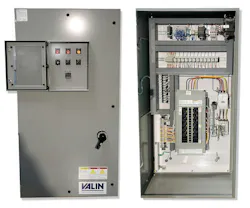
In industrial environments, enclosure selection is not simply a matter of size or layout. It is fundamentally about protection for personnel, equipment and overall system reliability. Yet while many professionals are familiar with the term “NEMA,” fewer understand exactly what it represents or how its ratings should guide specification decisions.
The National Electrical Manufacturers Association (NEMA) is the organization that defines enclosure standards used throughout North America. These standards apply primarily to industrial applications and establish clear performance expectations for how enclosures protect against environmental hazards.
At its core, a NEMA rating indicates the degree of protection an enclosure provides against specific environmental conditions. The rating also specifies what type of exposure an enclosure can withstand and whether it is intended for indoor, outdoor, hazardous or non-hazardous environments.
Non-hazardous vs. hazardous
For many industrial panel builders, the majority of projects fall within non-hazardous locations. Non-hazardous enclosures commonly include Types 1, 2, 12, 12K and 13. These are typically used across general industrial settings where explosive atmospheres are not present.
Hazardous location enclosures fall under different classifications, including types 7, 8, 9 and 10. Type 10 enclosures are associated with Mine Safety and Health Administration (MSHA) requirements.
Understanding whether a project involves hazardous classification is the first step in narrowing enclosure selection.
Indoors
When specifying an enclosure for an indoor industrial setting, Type 1 is often the go-to option. A Type 1 enclosure provides a degree of protection for personnel and protects internal components from dirt within a facility environment.
Because it is not designed to guard against water intrusion or corrosive conditions, Type 1 is typically more economical than higher-rated enclosures. For projects where environmental exposure is minimal, selecting a Type 1 enclosure can be a cost-effective solution.
This demonstrates an important principle in enclosure specification. It’s critical to align protection with actual risk. Investing in a higher-rated enclosure than the environment demands increases cost without necessarily improving performance.
Understanding knockouts
In indoor industrial environments where additional protection from dust and debris is required, Type 12 enclosures are commonly used. A distinction exists between Type 12 and Type 12K.
Type 12 enclosures are supplied without knockouts, while Type 12K enclosures include knockouts. A knockout is an opening in the enclosure meant to accommodate devices or components mounted to the panel.
In some operations, knockouts are handled by third-party providers due to the tooling requirements and time involved. The choice between 12 and 12K ultimately depends on whether field devices or accessories must be mounted through the enclosure wall.
Outdoors
When enclosures are outdoors, environmental exposure becomes a more significant factor. Types 3 and 4 are commonly used for both indoor and outdoor applications.
Both ratings provide protection against outdoor elements. However, Type 4 enclosures offer an additional layer of protection compared to Type 3. As enclosure ratings increase, within the outdoor-specific ratings, they generally correspond to greater environmental resistance.
For outdoor installations that do not involve corrosive exposure, a Type 4 enclosure is often appropriate. These enclosures are typically constructed from carbon steel and are designed to protect against rain and snow.
Get your subscription to Control Design’s daily newsletter.
The decision between Type 3 and Type 4 often comes down to the degree of protection required. If additional safeguards against water intrusion or environmental exposure are needed, Type 4 provides enhanced performance.
Corrosion resistance
In environments where corrosion is a concern, material selection becomes critical. This is where Type 4X enclosures play a role.
A Type 4X enclosure is typically constructed from stainless steel and is designed to provide corrosion resistance in addition to the environmental protections offered by Type 4. These enclosures protect against rain and snow.
Washdown scenarios are common in certain industrial settings. For example, facilities may periodically shut down systems to conduct cleaning operations that involve spraying down equipment. In these cases, a stainless steel 4X enclosure offers durability and protection that carbon steel cannot match.
Corrosive environments may also exist in oil refineries or other facilities where equipment is exposed to substances that could cause rust or material degradation. In such conditions, the corrosion resistance of stainless steel justifies the higher material cost.
However, if an outdoor environment does not present corrosive hazards, specifying a Type 4 enclosure instead of a 4X can provide adequate protection at a lower cost. Stainless steel 4X enclosures are significantly more expensive than their carbon steel Type 4 counterparts, reinforcing the importance of selecting only the level of protection truly required.
The decision path
Enclosure selection can be approached as a decision tree:
- Is the location hazardous or non-hazardous? This determines whether types 7–10 must be considered or whether types 1, 2, 12, 4 and 4X are appropriate.
- Is the enclosure installed indoors or outdoors? Indoor environments may only require Type 1 or Type 12, while outdoor environments typically call for Type 3, 4 or 4X.
- Is corrosion a concern? If so, 4X stainless steel construction may be necessary. If not, carbon steel Type 4 may suffice.
- Are knockouts required? If pilot lights, heat sinks or other mounted components are needed, a 12K configuration or custom knockout work may be required.
By walking through these questions, engineers and project managers can match enclosure performance to real-world conditions without overspecifying.
Protection
Ultimately, NEMA ratings exist to bring clarity and consistency to enclosure performance. They define expectations for how equipment will withstand environmental hazards and help ensure both safety and reliability.
The key is understanding what each rating truly represents. Each designation has specific characteristics that matter in application. From basic indoor Type 1 panels to stainless steel 4X enclosures designed for corrosive washdown environments, selecting the right enclosure is about balancing risk, performance and cost.
In industrial settings, where uptime and safety are paramount, that balance makes all the difference.
About the Author
 Jason Gaines
Jason Gaines
Valin
Jason Gaines is an engineering manager, process heat, at Valin, a subsidiary of Graybar. Valin serves the technology, energy, life sciences, natural resources and transportation industries. For 50 years, it has offered personalized order management, on-site field support, comprehensive training and applied expert engineering services.