How to achieve deterministic edge performance in extreme thermal environments
Key Highlights
- Modern edge controllers use dual-operating system architectures to run real-time PLC logic and high-level edge software simultaneously on dedicated CPU cores, ensuring microsecond determinism without interference.
- High-performance controllers must be rated for extreme temperatures without CPU de-rating to prevent cycle overruns and timing issues that can occur when systems sacrifice performance for heat control.
- To prevent premature hardware failure in data-heavy Linux and Docker environments, organizations should prioritize high-endurance eMMC storage over standard SD cards to manage frequent log writes and persistent data mapping.
Manish Sharma is global marketing and business development leader for Emerson’s Machine Automation Solutions business and is responsible for its portfolio targeting energy and process industries like power, renewables, hydrogen, hydrocarbons, semiconductor and water. He has 25 years of experience in marketing, product management and control systems and R&D. He holds a bachelor of engineering degree in marine engineering from Marine Engineering and Research Institute (MERI), India, and a master of business administration (MBA) degree from IIM, Ahmedabad, India. He also has three U.S. patents on process controls technologies.
What real-time operating system or runtime environment does the edge controller use, and what deterministic performance can it guarantee for control tasks?
Manish Sharma, global marketing and business development leader, Emerson Machine Automation Solutions: The PACSystems RX3i can handle microseconds of deterministic performance on the VxWorks operating system. This is critical for modern applications like motion to reduce jitter.
One thing that makes Emerson’s edge controller unique is that the PACSystems runtime for PLCs and the PACEdge software operate in parallel in the same system. Two cores run the runtime, and two run the PACEdge software without additional licensing. It’s an intuitive, cybersecure, out-of-the-box solution that provides both control and edge capability.
For security, should the edge device support hardware-accelerated encryption, such as TPM 2.0, for TLS/SSL certificates when pushing data to the cloud or an on-premise MQTT broker?
Manish Sharma, global marketing and business development leader, Emerson Machine Automation Solutions: Whether hardware acceleration for encryption is required depends heavily on the expected communication bandwidth and available compute resources. In typical edge controllers, data bandwidth is moderate, and the main processor does not have difficulty encrypting/decrypting traffic. If, however, a specific use case aggregates data from many controllers and acts as a gateway, then communication bandwidth will grow.
With regards to TPM, it is typically not oriented at the acceleration of encryption, rather for secure storage and secure operations. Hence, it is great for storing the private keys and specific signing operations, but not necessarily for the bulk encryption.
Edge controllers often run much hotter than traditional PLCs because of their high-performance processors. Why is it important to know thermal limits?
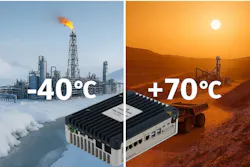
Manish Sharma, global marketing and business development leader, Emerson Machine Automation Solutions: When users effectively run two operating systems on one unit, that unit is going to heat up. Often, to offset this, edge controllers will de-rate the CPU when the system reaches high temperatures, trading performance for temperature control. This can cause cycle overruns, timing issues, and other problems when units are operating in the field, thereby limiting either the performance of the application or the choice of deployment at particular applications. Organizations should seek out controllers that can meet operating temperatures of -40 to 70 °C with no de-rating of performance or physical deterioration of the system both in normal runtime and at extreme events.
What containerization or virtualization technologies, such as Docker or Kubernetes-based frameworks, are supported for deploying applications at the edge? How does the operating system support standard Docker runtimes, and how is the persistent storage handled to prevent SD card or EMMC wear-out from frequent log writes?
Manish Sharma, global marketing and business development leader, Emerson Machine Automation Solutions: Users want simplicity when deploying edge applications. Containerization, such as Docker containers, is a powerful technology that is being used in many Linux-based systems. Not only does it help users easily add, remove and upgrade specific applications, it also provides security benefits by isolating each application from the other ones.
Get your subscription to Control Design’s daily newsletter.
To retain the data between the container starts, different techniques of mapping volumes on the disc to container are being used. As rightfully noted, modern Linux applications can generate significant use of the disc by writing logs; however, container configuration options do support ways to limit the log size and the amount of data being logged in the first place. Certainly, it will result in higher load on storage devices, hence SD cards are not recommended and eMMC devices with sufficient size and write endurance should be selected.
Why is it important to know which industrial communication protocols an edge controller natively supports and whether additional protocols be added through software or middleware?
Manish Sharma, global marketing and business development leader, Emerson Machine Automation Solutions: It is important because there are going to be specific protocols an organization wants to use. Knowing that an edge computing solution supports the right protocols not only simplifies setup and configuration, but also streamlines lifecycle maintenance as teams do not need to worry about complications from middleware solutions when making changes or updates.
In addition, protocol selection has a significant impact on security and performance. OPC UA is the most secure protocol available. MQTT broker makes passing data an easier and much lower-bandwidth process. Forward-thinking organizations want to take advantage of these capabilities; therefore, they want to know the solutions they put in place support the protocols they need.
How does an edge controller handle data buffering and store-and-forward functionality if connectivity to the cloud or enterprise systems is interrupted? What should the local storage capacity be for that data in case of a signal drop?
Manish Sharma, global marketing and business development leader, Emerson Machine Automation Solutions: Much of this functionality is based on the way the system is configured. Toolsets like SQL can be used to configure the system to identify when connection is lost and begin storing in a different format and location. Typically, the edge devices have space allocated that will allow this capability. Then, when connection is restored, it will send the data on.
Since, in most cases, the data is coming from the process side, it is typically just mathematical data, so the systems can handle a lot of data.
How can edge controllers integrate with existing SCADA, MES or cloud platforms for data exchange and system orchestration?
Manish Sharma, global marketing and business development leader, Emerson Machine Automation Solutions: Using the most advanced edge controllers, it is even easier to integrate systems than with traditional PLCs. Today the systems use data formats that are easy to implement into software like SCADA, MES, cloud platforms and more. Now, the data is put into a format that is easy to use. Moreover, today teams can connect from the edge side of the controller securely and directly to cloud platforms.
That being said, unless there is a strict need to connect the applications like SCADA, MES or historian to the edge side of the edge controller, it’s better to continue with the traditional route of connecting via the process side and let the edge compute side be dedicated to edge computing and driving process optimization. This keeps the traditional view-and-control philosophy on the process side and latest edge compute-drive outcomes compartmentalized.
About the Author
 Mike Bacidore
Mike Bacidore
Editor in Chief
Mike Bacidore is chief editor of Control Design and has been an integral part of the Endeavor Business Media editorial team since 2007. Previously, he was editorial director at Hughes Communications and a portfolio manager of the human resources and labor law areas at Wolters Kluwer. Bacidore holds a BA from the University of Illinois and an MBA from Lake Forest Graduate School of Management. He is an award-winning columnist, earning multiple regional and national awards from the American Society of Business Publication Editors. He may be reached at [email protected]
 Leaders Logo
Leaders relevant to this article: