Control vs. computing: Rethinking machine control architecture
Key Highlights
- PLCs excel at predictable, deterministic real-time control and sequencing, whereas industrial PCs are optimized for complex data manipulation and heavy software workloads.
- High-bandwidth applications such as machine vision, artificial intelligence and complex trajectory generation are fundamentally computing problems best offloaded to an industrial PC.
- Implementing PC-based control is not about replacing the PLC, but rather partitioning tasks so each platform handles the functions best-suited to its strengths.
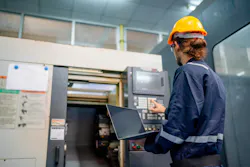
Programmable logic controllers (PLCs) are capable of doing far more than the controllers many of us first encountered years ago. Processing power, memory, communications and motion capabilities have all expanded, allowing a single controller to handle increasingly sophisticated machine functions. But “capability” and “suitability” are not necessarily the same thing. Just because a PLC can perform a function does not mean the function belongs in the PLC.
That situation is becoming more important as PC-based control continues to evolve. Rather than viewing an industrial PC simply as an alternative to a PLC, engineers can consider it another computing resource within the machine. The real question becomes: Which functions are best-suited to deterministic control, and which are better treated as computing problems?
Control vs. computing
The distinction starts with how these platforms are designed. A PLC is built around deterministic machine control. It reads inputs, executes logic and produces outputs in a predictable cycle. This makes it particularly well-suited for sequencing, interlocks, I/O processing and other functions that must respond consistently to changing machine conditions.
An industrial PC approaches the problem from a different direction. It is designed to handle varied software workloads, often simultaneously. As a machine begins processing large amounts of data or running increasingly sophisticated algorithms, that distinction can become important. The PC is not simply a faster PLC. It provides a computing environment better-suited to certain types of work.
What pushes a function toward the PC?
Several characteristics can indicate that a machine function may be better-suited to PC-based control. Large datasets, complex mathematical calculations, image processing and sophisticated algorithms can all demand computing resources beyond what is practical or desirable in a conventional PLC control program.
The issue is not necessarily processing speed. It is the nature of the workload. A control program might need to determine whether a sensor is on or off within a predictable cycle. A computing application might need to analyze thousands of data points, manipulate an image or execute a complex algorithm before producing an answer. Both are legitimate automation tasks, but they are fundamentally different problems.
Machine vision
Machine vision provides a good example. A PLC can trigger a camera, receive an inspection result and determine what the machine should do next. Those are natural control functions. Processing the image itself is a different matter.
As vision applications become more sophisticated, they may involve high-resolution images, pattern recognition, dimensional analysis and increasingly advanced algorithms. An industrial PC provides the processing resources and software environment to handle that workload while the PLC remains responsible for the deterministic machine response.
This division can also simplify the overall architecture. Instead of forcing the PLC to perform increasingly complex image-processing tasks, the PC can handle the computational work and return the resultant information the control system actually needs. The result is not necessarily a PC replacing the PLC. It is each platform performing the portion of the task that fits its strengths.
Get your subscription to Control Design’s daily newsletter.
AI and advanced analytics
The same idea applies to AI and advanced analytics. Machine-learning inference can require substantial memory and processing resources, particularly as models become more sophisticated. An industrial PC can provide access to CPUs, GPUs and software frameworks that are better-suited to these workloads.
The PLC can provide the real-time machine data while the PC performs the analysis. This creates another example of PC-based control extending the machine's computational capabilities without requiring every function to become part of the PLC program.
Motion
Motion is another area where the distinction can become useful. Dedicated motion controllers remain well-suited for deterministic coordinated motion, but PC-based control can take on computationally intensive tasks surrounding that motion, such as complex trajectory generation, robotics or kinematic calculations.
Again, the important question is not which platform can technically perform the task. It is which platform provides the better environment for the work involved.
The new design question
This suggests a different way to approach machine architecture. Instead of asking simply, “Can the PLC do this?” engineers can ask, “Is this fundamentally a control problem or a computing problem?”
Functions that require deterministic interaction with machine I/O, sequencing and real-time control remain a natural fit for the PLC. Functions involving large amounts of data, sophisticated algorithms or computationally intensive processing may be better-suited to an industrial PC.
PC-based control therefore does not have to be viewed as a replacement strategy for PLCs. It provides another way to divide the machine's workload, allowing deterministic control to remain where it belongs while moving increasingly complex computational tasks onto hardware designed to handle them.
The next time you're about to add another sophisticated function to a PLC, don't just ask whether the PLC can do it. Ask whether it belongs there or whether the machine has become a computing problem that calls for a PC.
About the Author
 Joey Stubbs
Joey Stubbs
contributing editor
Joey Stubbs is a former Navy nuclear technician, holds a BSEE from the University of South Carolina, was a development engineer in the fiber optics industry and is the former head of the EtherCAT Technology group in North America.
Related
 Leaders Logo
Leaders relevant to this article: