3 finalists announced for 2026 Hermes Award
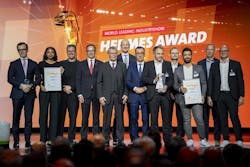
The 2026 Hermes Award finalists have been announced and include Festo, Schaeffler and Ziehl-Abegg.
Siemens'AI-powered industrial copilots won the Hermes Award in 2025.
Schunk won the 2024 Hermes Award for its 2D Grasping Kit.
In 2023, it was Bosch Rexroth's Smart Flex Effector earning the Hermes Award.
The annual award acknowledges products that demonstrate a notably high level of technological innovation, market maturity and cost-effectiveness.
"The three nominees address social challenges and show specific solutions,” said Prof. Dr.-Ing. Holger Hanselka, jury chairperson and president of the Fraunhofer Society. “Manufacturing medical products, automation and robotics cost-effectively, as well as replacing critical materials, are factors that provide new impetus for growth and employment and strengthen the visibility of our country as a driver of innovation. I would like to congratulate the nominees on this outstanding achievement."
Festo: The nominated project involves highly integrated manifolds—multi-layer plastic distributor plates that control, dispense and mix liquids while monitoring flow rates using sensors. Compared to conventional channel plates, which mainly perform passive distribution functions, the Festo manifold integrates active functions within a very compact installation space: optimized mixing channels, media-separating valve technologies with minimized dead volume and integrated sensors for temperature, flow, pressure, color and pH value. The challenges lay in designing and manufacturing the user-friendly platform. The technical innovation is the combination of finely structured, multilayer microchannels and integrated valve and dosing elements, directly embedded sensory measuring points and a manufacturing process design that makes these functionalities economically feasible in series production. This enables more compact, more reliable and more easily validated systems for biotech, medical technology and semiconductor applications.
Schaeffler: A platform for highly integrated actuators was nominated, which has been specially designed for use in the articulation points of humanoid robots. The platform includes servo motors with integrated power electronics and encoders and can be configured with two-stage planetary or shaft-mounted gear units depending on customer requirements. Development of the actuators consistently pursued the aim of minimizing installation space and achieving a high continuous torque. Compared to the latest solutions on the market, the installation space has been reduced by around 20%. The copper fill factor in the frameless permanent magnet synchronous motor (PSM) machine has been increased to ensure a low temperature level at high torques. The actuator platform significantly reduces system costs and thus creates a key prerequisite for the rapid scaling of service robotics.
Ziehl-Abegg: The company has been nominated for an electric synchronous elevator machine that does not require magnets made from rare earth metals, yet still offers consistently high performance. The new elevator machine works with ferrite magnets and entirely dispenses with critical raw materials such as neodymium or dysprosium, which were previously considered indispensable for high-performance drives due to their high-power density. The innovation lies in a completely new motor design. As a result, torque density remains high, running smoothness is maintained, and energy efficiency is on a par with previous premium solutions. Dispensing with rare earth metals reduces dependence on critical raw materials. Ferrite magnets, on the other hand, are available worldwide, have a reliable supply chain and are much more environmentally friendly to produce.
The Hermes Award winner will be announced at the official opening ceremony of Hannover Messe on April 19. Federal Minister of Research, Technology and Space Dorothee Bär will present the award.