Vention, FANUC and Teradyne demonstrate partnerships at Automate 2026
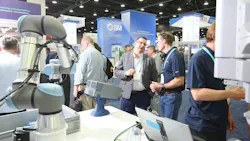
Vention, the digital-first industrial automation platform, and FANUC America, provider of industrial robotics and factory automation, expanded their collaboration focused on simplifying industrial robot deployment through AI-powered programming, digital twin technology and modular automation.
Vention's AI-powered automation platform is designed to enable FANUC industrial and collaborative robots to autonomously generate collision-free motion paths while providing integrated monitoring and remote support capabilities that simplify deployment and ongoing operation across a wide range of manufacturing applications.
Vention's AI-powered automation platform enables FANUC industrial and collaborative robots to autonomously generate collision-free motion paths while providing integrated monitoring and remote support capabilities that simplify deployment and ongoing operation across a wide range of manufacturing applications (Figure 1).
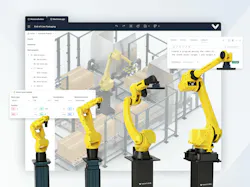
The collaboration combines FANUC's industrial and collaborative robot portfolio with Vention's unified automation platform, enabling manufacturers to design, simulate, deploy, and operate robotic systems from a unified environment. The expanded platform now supports multiple FANUC robot families, including CRX collaborative robots, LR Mate industrial robots, LR-10iA series robots, M-710iD series robots, and M-20iD series robots.
By integrating collision-free path planning, no-code and Python programming capabilities, the companies are helping manufacturers reduce commissioning complexity while accelerating automation adoption. Powered by Foundation Stereo, an NVIDIA Isaac open model that helps robots see depth using stereo cameras, the system generates a real-time 3D understanding of the workspace using a zero-shot stereo depth estimation, enabling MachineMotion AI to build a digital twin and automatically compute collision-free robot paths.
These capabilities now extend across FANUC's robotic portfolio, enabling manufacturers to deploy a wide range of applications, from machine tending and pick-and-place to palletizing, welding, and high-speed industrial automation.
The combination is designed to enable users to design automation systems using modular, pre-validated components that work together seamlessly. Manufacturers can generate and validate logic, simulate robotic motion and test cell interactions before deployment.
"By extending Vention's platform to FANUC industrial robots, enterprise manufacturers in heavy industry can move from automation design to production much faster," said Étienne Lacroix, CEO of Vention. "Combined with FANUC's proven reliability and long-standing track record in industrial automation, this partnership gives manufacturers a dependable path to scaling production automation."
"We're seeing strong demand from manufacturers for automation that's easier to deploy and faster to bring online, especially as labor challenges continue," said Dick Motley, director, authorized system integrator network at FANUC America. "Many companies want to automate but are looking for solutions that reduce complexity and are easier to implement. Vention's AI-powered platform helps customers deploy FANUC's industrial and collaborative robots, allowing them to get up and running more quickly while maintaining the performance and reliability they expect from FANUC."
Vention and Teradyne Robotics also collaborated to accelerate the deployment of modular automation. Built on Vention's MachineBuilder software and centered around Universal Robots' family of collaborative industrial robots (cobots), the initiative extends Vention's MachineBuilder to create a specialized platform that allows manufacturers to design, program and operate modular work cells within a unified digital environment.
The optimized digital twin environment developed by Vention and Teradyne Robotics allows users to design, program and simulate modular Universal Robots cells within a unified digital environment (Figure 2).
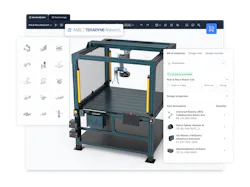
This collaboration is designed to deliver integrated, end-to-end automation built around an application-specific approach. By leveraging Vention's technology, Teradyne Robotics can provide its customers with a ready-to-configure digital environment.
"This collaboration reflects our conviction that robotics adoption must become faster, simpler, and more scalable for manufacturers of all sizes. By combining Vention's digital twin expertise with the Universal Robots capabilities, we are creating a new way to design modular robotic cells -- one that shortens time to value while maintaining the flexibility required in modern manufacturing," said Vention’s Lacroix.
"For our customers, the real breakthrough is moving from concept to a production–ready solution with confidence,” said Justin Brown, chief commercial officer of Teradyne Robotics. “This collaboration enables us to create high–fidelity simulations for our customers that reflect real–world kinematics. That means less trial and error, faster validation, and a shorter path from design to deployment."
Building on a multi-year collaboration, this next phase moves beyond hardware compatibility to deliver a deeply integrated digital experience tailored to the needs of collaborative robot users.
A dedicated interface within Vention's platform that is pre-loaded with the technical specifications and capabilities of the entire UR cobot line ensures that every design is build-ready and technically viable.