How healthy is your supply chain?
Key Highlights
- Adopting open architectures and vendor-agnostic standards is essential for machine builders to avoid vendor lock-in and gain the flexibility needed to swap components during supply chain disruptions.
- Proactive staffing and specialized procurement roles are becoming critical for manufacturers to manage inventory forecasts and navigate the risks associated with sourcing alternative components.
- Emerging technologies like AI and digital twins are streamlining the transition between hardware platforms by assisting with code generation and allowing for virtual validation before physical implementation.
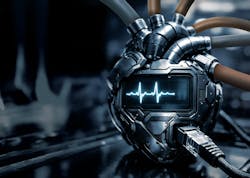
The combination of technology and market forces is reshaping the automation supply chain for machine builders. In November, five industry veterans discussed how to navigate the changing landscape in the Machin Automation Supply Chain Strategies webinar that I hosted. It was the first of a three-part series.
The manufacturing sector’s labor shortage continues to increase the demand for robotics and artificial intelligence (AI), which in turn accelerates the need for controllers, motors, drives, sensors, processors and other components.
AI-powered analytics can improve supply chain resilience, allowing companies to foresee disruptions, optimize inventory and identify alternative component sources.
At the same time, the push toward open architectures and vendor-agnostic automation mitigates the risks of vendor lock-in, creating a more competitive and diversified marketplace. This shift favors suppliers who adhere to common, published standards, enabling system integrators and machine builders to source from a broader, more flexible network of specialized component providers and clearing potential regional bottlenecks.
Finally, market forces dictate that manufacturers innovate for efficiency and speed, which clashes with the cost and complexity associated with finding or designing substitute components, forcing a trade-off between supply chain security and performance specification.
Navigating these hazards and avoiding a backlog similar to the one we experienced following the COVID pandemic, not to mention the ever-changing minefield of tariffs, can be daunting.
Where can a machine builder turn for answers?
During the previous component shortage, which was caused largely by COVID-19, many machine builders and system integrators and manufacturers were looking at alternative brands for their electronic components, some more successfully than others.
The art of alternative procurement
Vendor-agnostic technology and open architectures have become important considerations for relieving supply-chain pressure, but there can be downsides to venturing outside of a closed-component ecosystem.

“I'm a little bit lucky here,” says Dr. Brian Romano, director of technology development at Arthur G. Russell (AGR), a machine builder and system integrator in Bristol, Connecticut (Figure 1). Romano also teaches at two universities, serves as chair of the ISA’s IIoT Technical Committee and was awarded the 2022 ISA SM/IIoT Division Leader of the Year Award and was named an ISA Fellow in 2025. “I manage the control systems engineering department and the electrical assembly, and we have a procurement team just for my department. They're not just procurement.”
The individual in Romano’s department has been with the company for more than 30 years. “He knows how we go to business, what we buy and how we buy it,” explains Romano. “So, the shift to alternative brands he's procuring—let's make up a thing here, 30 breakers. If it's a dc breaker, it really doesn't matter who it is, unless the customer has a very definite spec in their user requirement specification (URS). If they do, then we have to buy what we have to buy. But, other than that, he does a great job of canvassing our vendors, finding the most agnostic that is still quality and has the availability on the shelf with the best price.”

At Hargrove Controls + Automation, a system integrator in Mobile, Alabama, where Karen Griffin, PE, is vice president and leads a team of 150 individuals, including automation engineers and specialists, there used to be a default (Figure 2). “Whatever brand it was, different shops had different defaults. That's what you went to, and it was easy,” she explains. Griffin is the former chair of the board of the Control System Integrators Association (CSIA). She has more than 26 years of experience in automation and 19 years of experience as a system integrator.
In 2024, she was presented the distinguished Charlie Bergman "Remember Me" Award from CSIA and received the Auburn University Chemical Engineering Outstanding Departmental Alumni Award from the Samuel Ginn College of Engineering.
“Now we have people that are tasked with finding alternatives, finding the best pricing for a given time,” Griffin explains. “That's not a job function that we really put a lot of emphasis on, especially when it came to the world of commodity products. Now we're having to staff, and we're having to look at our forecast, making sure we've got the appropriate number in our stores for our future projects because our clients don't want to hear that we cannot deliver within the timeline they need.”
Clients still have outages that they plan around, she notes. “They still have production requirements that they're planning around. They need us to come up with opportunities to deliver, and that does oftentimes require that we do things differently,” Griffin says. “Having people on your staff that are constantly keeping up with these products that we commonly use and where the best pricing is and where the availability is—it's just something we didn't have to account for in the past.”

The overall architecture of projects and machines requires using as many open standards as possible, recommends Bernd Raithel, director of product and solution development, Siemens Factory Automation, United States, where he’s been for more than 20 years (Figure 3).
“If you use Profinet, EtherNet/IP, EtherCAT or OPC UA, if you go into the standards, then you will find an I/O vendor that supports the standards,” Raithel explains. “You have options. That's one thing just to have flexibility in what you're doing, even if it's not your standard, but you can move around.”
Raithel also sees Siemens customers who indicate their software-based controllers allow them to use whatever PC they want, who say, “Let's use a software controller or even a virtual PLC and run it in a data center.” This lends itself to a hardware-agnostic solution where you run your PLC code, he explains.
“You still need a solution for the drives. You still need a solution for the breakers and I/Os. It's not going to go away,” says Raithel. “That's really where open communication standards help—so that you're flexible between vendors.”

It starts at the very beginning when you do your selection of control platforms, explains Daymon Thompson, director or product management at Beckhoff, where he leads the company’s U.S. product management and advanced applications teams (Figure 4). “Using something that's truly open, like EtherCAT or Profinet, you can use other I/O or other devices,” he says. “EtherCAT, for example, has 7,000 member companies, so, if you had to pivot away and find something else, it's not a complete re-engineering.”
It's also about the platform speaking multiple protocols, Thompson continues. “If you can't get that device that happens to speak EtherNet/IP, but you can get something similar that speaks a different protocol, you can pivot pretty quickly. Your engineers do not have to switch the whole PLC control to do it,” he explains.
“We did hear some horror stories during that time when there was a customer that could get the I/O, but they could not get the controller, so they wanted to go find another controller to use the same I/O,” recalls Thompson. “And while it was a standard fieldbus, the provider of the I/O had done some proprietary things on that standard fieldbus, which means they couldn't use another master. They couldn't use another controller with that same I/O family.”
This required redesigning all of the I/O layout, including electrical drawings, which was quite an effort, notes Thompson.
“The software-based controllers are not like the old-school, hard real-time controllers, but you can switch out some of the PC hardware underneath,” Thompson continues.
“Especially coming out of COVID, everybody wanted to be very vendor-agnostic,” he remembers. “‘I just want to move my code around. I just want to pick whatever controller I want.’ It sounds great in theory, but there are a few things about that. Your initial code had to be written in something that is portable, so, if you didn't pick a vendor already that chose the IEC 61131 programming standard, you're rewriting the code.”
Even if you have a vendor that's using the 61131 programming standard, but not following things like PLCopen, the code and the syntax are the same, but you're still rewriting a lot of the logic and the blocks because they didn't follow another open standard, explains Thompson. “And then we still got into more nuances where a vendor would support 61131 and PLCopen, but they had no clean way of exporting the code into another platform because they didn't support things like the PLCopen XML exchange format, so you couldn't take the code between controllers. You're copying and pasting it. It was a really terrible process,” he notes.
“And then the last mile, so to speak, on making things truly agnostic, is always interacting with certain hardware,” says Thompson. “If you're interacting with a serial port, for example, how you interact with the serial port between different vendors is not standardized, so that code and that function block and library is going to be a little bit different.”
The dream of having one code base that sits across multiple platforms might work if you have a very simple application, but, when it gets into really complicated ones, “there's always going to be a couple of little nuances that need to be thought about, if that's the strategy,” warns Thompson.
Distribution channels

Get your subscription to Control Design’s daily newsletter.
“They got used to buying their toilet paper from home. And then they brought that into the workplace. Now they're able to utilize more global distribution channels where they maybe have a larger offering,” explains Halvorson, who’s provided technical strategic marketing support to key automation-focused supplier partners for 15 years.
“I don't think that's ever going to replace local distributors,” he predicts. “There's always going to be a need for them, but having the ability to source from these larger global distributors, where they can get a wider offering from a wider selection of suppliers, is going to be critical for them in helping them to absorb some of the delays in the supply chain and helping them to get better pricing. A lot of times you can get the product on their doorstep in about the same amount of time as it takes for at least some of these local distributors.”
DigiKey is an online stocking distributor, notes Halvorson. “We stock 95% of the customers’ needs in-house. As a distributor, it's our job to hold inventory for the manufacturer, for the OEM, making sure that, when the customer needs it, we have it,” he says.
“I do see reps as a necessary piece of the puzzle,” Halvorson explains. “Being able to get in close with those customers, being able to go to the customer's facility on Tuesdays and find out what they need is important still. As we move forward in the e-commerce space, you’re going to see a lot more distributors actually carrying inventory. That was one of the big lessons learned from COVID. We need to have inventory. It'll carry the supply chain through any crisis.”
For Hargrove Controls + Automation, it always boils down to risk, Griffin explains. “Our clients, generally speaking, want us to take the risk on substitutions,” she says. “They want to know that whatever we supply them with is going to work. We'll oftentimes have conversations with them about alternatives, things that are not the standard that they've been using in the past.” As long as you can prove the alternative is going to work the way that product’s worked in the past and over the long term, that's fine, Griffin notes.
“Oftentimes, it's really an assignment of risk, and you can have good mature conversations with your clients on how to best manage that risk,” recommends Griffin. “Obviously we're a system integrator. We can't take all of the risk. We wouldn't stay in business if we did. Our owners know that, but they need to know that we also are willing to stand behind what we're asking them to take. You just have those conversations up front. Maybe we can have a little trial in our office so we can show that it works. We can get the vendor to supply the data on the longevity of it. Maybe we can get an additional warranty, and we can pass that through. Those are the types of conversations I would have with them, but for us it always boils down to risk and how we appropriate that risk amongst the parties invested in it."
Should AI write code?
The adoption of AI to write controller code has been slow, but companies continue to investigate and experiment with it. “I think we will see more of it,” foretells Raithel. “It's not there yet, but we at Siemens are working on co-pilots, especially for engineering, for TIA Portal, and I guess every other automation vendor is working on that, as well.”
Younger engineers will benefit from the ability to get things done more quickly or start projects more quickly, explains Raithel. “It will help switching between vendors. It will help in many ways to reduce the time,” he says.
“The other part, which we also saw during COVID, was combining it with digital twins and simulation,” Raithel notes. “When you switch from Vendor A to Vendor B, you might need to rewrite some of the logic, but you don't have to retest everything on a real machine. You can do it in your lab. You can do it in the office or in a virtual environment, and you can validate the new code you have for a different platform and then make sure it's actually working before you go to the machine.”
Technologies such as AI, simulation and digital twins will be extremely important in the future to not only shorten timelines, but also to help with flexibility, Raithel says.
AI code generation is being trialed at Hargove, discloses Griffin. “We might try to put some engineering data into one of these AI platforms that has a large language model (LLM) behind it and say, ‘Generate this code in four different flavors of vendors.’ On the very simple stuff, it does work, but it's just not there yet on the complex stuff.”
Will it get there? Griffin admits there are many drivers behind this potential success, but the industry as a whole would benefit from it.
“Anything that you can do to reduce the complexity around the work you're currently performing allows you to increase the complexity around something else and thereby drive greater value to your clients,” Griffin explains. “If we can free ourselves up from the tasks that we think of as simple in nature, then we have freed ourselves up to do the things that are more complex and provide more value.”
Hargrove and other technology companies will continue to trial. “We're interested in it. We love to automate things, not only the things in plants, but also in our workflows, so we're looking forward to it,” explains Griffin.
Beckhoff’s Thompson recalls the adoption of virtual commissioning during COVID as builders tried to get as far as they could while waiting on parts. So, it became necessary to start adopting those tools.
“On coding with AI, it depends on how well it does on the language because it's all the training data,” Thompson explains. “For example, if you need to write some JavaScript, it's pretty amazing at what LLMs can do for JavaScript. But, when you get into structured text in 61131 languages, it’s a bit less. When you get into graphical languages like ladder, it’s even less. It really depends on the language you're trying to generate, as well.”
AGR’s Romano remembers a recent conference, where a company took a code written in a specific supplier’s language and stripped it and turned it into pseudocode, so all of the company nuances were taken away. Then the LLM worked on the pseudocode, so, if you offered any suggestions in the LLM, it could make the change.
“If you wanted to say, ‘I need to put this into a Siemens PLC or a Rockwell PLC,’ it would take the pseudocode and had a module that would actually reapply the level, the language, the nuances of the particular platform, and put it back,” Romano explains. “It wasn't 100%, but it was an interesting approach, being able to take this and write it in pseudocode and make it versatile to any platform.”
About the Author
 Mike Bacidore
Mike Bacidore
Editor in Chief
Mike Bacidore is chief editor of Control Design and has been an integral part of the Endeavor Business Media editorial team since 2007. Previously, he was editorial director at Hughes Communications and a portfolio manager of the human resources and labor law areas at Wolters Kluwer. Bacidore holds a BA from the University of Illinois and an MBA from Lake Forest Graduate School of Management. He is an award-winning columnist, earning multiple regional and national awards from the American Society of Business Publication Editors. He may be reached at [email protected]
 Leaders Logo
Leaders relevant to this article: