How to make automation and process control ideas work
Key Highlights
- Huffman Engineering prioritizes highly customized, full-process automation over simple machine integration, ensuring that even similar facilities—like water treatment plants—receive unique solutions tailored to specific regulatory needs and operator goals.
- Industrial integration is increasingly focused on merging hardware with software to provide real-time business intelligence, allowing companies to improve sustainability and significantly exceed production targets.
- By maintaining expertise across multiple technology platforms and operating their own UL-certified panel shops, Huffman Engineering manages the entire project lifecycle from design and validation to training, specifically to minimize downtime in highly regulated industries.

“Making Ideas Work” at highly regulated businesses has its own set of unique challenges. “We take someone’s ideas for their manufacturing plant, pharmaceutical and life sciences organizations, water, wastewater, electrical or compressed natural gas utility or food and beverage plant and make them work,” says Wendy Huffman, co-owner, founder and CEO/CFO of Huffman Engineering, a CSIA-certified member of the Control System Integrators Association (CSIA).
Headquartered in Lincoln, Nebraska, Huffman Engineering is full-service custom engineering services firm focused on automation and control system integration from design to build, installation, testing, qualification and validation and training (Figure 1). The system integrator was founded in 1987 and now includes more than 60 employees, including 37 engineers, six computer science specialists, six project management professionals and eight automation technicians.
Huffman and her husband Howard, co-owner, founder and president, answered several questions about the company they’ve built and grown over the past 40 years (Figure 2).

Describe the machines you integrate. How many machines do you integrate on average each year?
Howard Huffman, president, Huffman Engineering: We complete about 100 full-scale projects annually and within those are control systems on multiple machines, devices and processes. We work with both IT and OT, software and hardware. Specifically on the machine side, almost all of those are on the industrial filling, packaging, forming machines and winders, extruders and material handling, and they are only a part of the processes we control. We do more automation and process control than machine control.
Highlight some of your most innovative integrations. What makes them unique?

Wendy Huffman, CEO/CFO, Huffman Engineering: We do more full process integrations than individual machine integrations, and nearly every process integration we do is unique (Figure 3). We have the benefit of entering each client’s industry, taking stock of what ide, they need to make work and helping them achieve that level of automation and control using hardware and software to help them grow their business.
As an example, we’ve taken someone else’s idea about taking dangerous compressed natural gas tanks and provided some proof stations for testing to ensure the safety of these tanks. We’ve helped control a winder application for making natural gas tanks and then tested them to ensure safety to all of their clients which is paramount to their business success.
Howard Huffman, president, Huffman Engineering: In another example, we can talk about how we utilize sustainability and renewable processes and helping with that. In the irrigation industry at a global manufacturer right here in the heart of the United States, we can automate a lot of things in terms of producing irrigation pivots now that could not be done years ago. Not only can we automate the process, but we can get information and data back to them during the process to help them know how product is being made and give them business intelligence on making their process more efficient. That in turn allows them to produce more at a lower cost. So, the processes we control really have a ripple effect on how these companies manage their businesses and the outcomes they can produce.
What percentage of your projects are standard vs. custom? What is the focus?

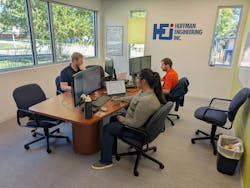
Howard Huffman, president, Huffman Engineering: One of the strongest selling points for our systems is that every system is unique, and so, even though there are similarities, we take great pride in listening to each client as if they were our first one (Figure 4). For example, we might do water or wastewater treatment and simulate the systems from location to location; we still have to listen to the client and make sure they’re getting what they truly want.
The process of treating water may be the same, but one location may need a software upgrade with additional data management capabilities, one water system may be looking to manage PFAS (per- and polyfluoroalkyl substance) outcomes, and another may be looking for methane gas capture, so although we may bring the knowledge of water or wastewater treatment from one plant to another, what the client is looking for and the operators need may be vastly different. In that way, in our eyes, it is still a custom project. We really approach each project in every industry we work with like that. Gaining a true understanding of what our client needs first and then bringing our expertise in technology, software and hardware processes to the table is important to us.
What is your core business? What industries do you work in? What type of manufacturers do you work with?
Wendy Huffman, CEO/CFO, Huffman Engineering: Our core business is full-service custom engineering focused on automation and control system integration. We work in highly regulated industries in the Midwest including pharmaceuticals/life sciences (human and animal health), water/wastewater, manufacturing/material handling, food and beverage, electrical utilities and natural gas, networking/data analytics/cybersecurity. Many of our clients are repeat clients because of the relationships we build with them. We hold fast to our core values:
- do the right thing
- embrace difficult challenges
- simplify the complex
- make others successful
- display anticipatory initiative
- be committed and disciplined start to finish.
And we strive to work with clients who embrace similar core values, so we can make a significant difference in the communities we live and work in.
Where does your integration take place?
Wendy Huffman, CEO/CFO, Huffman Engineering: The majority of our work is in the Midwest part of the United States, although we have been asked to do consulting and project work in other states and countries because of the success of our projects. We have completed projects in 23 states, Puerto Rico, Canada, Asia, Europe and South America. Our headquarters is in Lincoln, Nebraska with additional offices in Omaha, Nebraska, and Denver.
What are important trends affecting the industries you work with and types of machines you integrate?
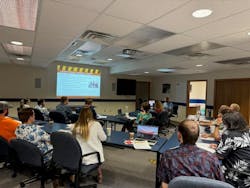
Howard Huffman, president, Huffman Engineering: Data, it’s all about data. We are seeing more and more integration between machines and data reporting. With continued focus on IIoT, our clients want to see their manufacturing and enterprise resource planning (ERP) systems tied together throughout all levels of their organization. There is a greater emphasis on machine learning, AI and cybersecurity and smaller robotics or collaborative robots. There used to be communication and interaction and safety strategies put in place, and the philosophy around safety used to be “don’t die, don’t lose an arm, don’t get a finger caught.” But now the qualification and validation requirements are more stringent and, in some industries, ever-changing (Figure 5). Manufacturers have moved from individual machines performing automation tasks to islands of automation held within silos to floors of automation reporting to other equipment. They’re looking to us as seasoned system integrators with the experience with both hardware and software to tie them together with manufacturing execution systems.
How much time does it typically take to go from design stage to installation? Do you have other projects that vary?
Howard Huffman, president, Huffman Engineering: Nothing is typical when you’re doing custom work. The kind of project makes a big difference, and the complexity of the system defines the timeline. Some smaller projects could be one month to six months, but we have very few projects where we’re seeing the same panels and building them over and over. Our clients traditionally come to us in one of two scenarios. Sometimes they have a current system that is running and something is not working or working as well as they would like it to, and they need our help to fix it, upgrade it or solve their pain point.
The other scenario they bring to us is that they are building something from the ground up, and they need our help with it from the very beginning—the design to the implementation—and, depending on how large the manufacturing line or the process, that could be a multi-year project incorporating various partners from additional engineering firms to electrical contractors and others. The complexity of each project determines the timeframe, but honestly there is no typical timeframe because we’re a system integrator and not an original equipment manufacturer (OEM).
How do you use digital twin software or other technology for the design process?
Howard Huffman, president, Huffman Engineering: The industry is definitely moving toward digital twin, and we’re seeing it more and more. As far as controls go, we will more often use Elan for 3D modeling or SolidWorks for machine design.
Get your subscription to Control Design’s daily newsletter.
What are your supplier preferences? How often do you rely on clients to dictate component choice?
Wendy Huffman, CEO/CFO, Huffman Engineering: We work with suppliers and manufacturers whose goal is to serve the end user. We want to partner with manufacturers and partners who are looking to give the best solutions to our clients. Oftentimes the end users have a preferred vendor they already use. Sometimes they ask our advice on which software/ hardware platform might work best in any given project. In that case our answer is always we want to do what the client wants and truly needs even if occasionally that means suggesting they use spare parts they already have on hand.
That’s also why we maintain expertise across multiple platforms and with multiple vendors because it’s really important to us to serve our clients well. We spend a lot of time and effort on professional development so we can continuously train on the latest technologies and platforms to be informed for our clients. We do work really hard at building and maintaining partner relationships with vendors we trust and we want to honor those at the end of the day, so we are both providing the very best solution for the end user. For Huffman Engineering it goes back to two of our core values—"Do the Right Thing” and “Make Others Successful.”
How does data enhance your machine integration? Do you integrate machines that use edge computing? Do you integrate remote connectivity to machines? How do the machines you work with use analytics?
Howard Huffman, president, Huffman Engineering: Data analytics are fundamental to everything we do in control system integration. We are consistently monitoring, reading, reflecting and recording data from a variety of machine interfaces that we have programmed to produce. That might be a manufacturing line, a pharmaceutical consumer or animal health line (Figure 6). It might be a food product line, or it might be a water or wastewater treatment facility, but all of the complex systems we design build and install require data inputs and data outputs. How we do that is based on our clients’ needs and their requirements for their operators. Much of that now includes remote access. And many of the systems we use allow us to provide actionable insights to automatically inspect and simulate a system before even building it.
What is required for typical maintenance on the machines you work with? How do end users limit downtime?
Howard Huffman, president, Huffman Engineering: Because we’re system integrators, much of this depends on the end user. Our goal at the end of the project is that we’ve trained their operators so well on their new or existing and improved system that they really don’t need us. So, the first question is, do they need support from us? If so, it may be a service call on an existing system, and we’re happy to help. But our primary goal is to work on large-scale projects with companies and become a trusted partner to their existing automation teams. We are known for our expertise and experience, quality, integrity and responsiveness, so, when they do need us, they can count on us for sure. And from a project standpoint, our careful planning and execution of factory acceptance tests (FATs) and consistent communication with the client is carefully crafted to catch any issues before we’re ever on site for startup. This is to ensure that we limit downtime as much as possible and are as efficient of a team as we can be.
Clarifying internal expectations early on, paired with direct communication about any changes in schedule or scope, can help streamline projects and ensure limited downtime. We know, the earlier we are able to become a part of the planning for process execution, the better we can help, especially on large complex systems with multiple players.
What other products or services do you manufacture or offer in addition to system integration?
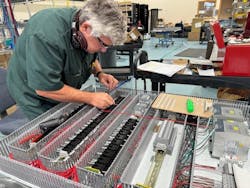
Wendy Huffman, CEO/CFO, Huffman Engineering: At Huffman Engineering, we are a full-service engineering firm focused primarily on automation and control systems integration. This means we consistently do automation and controls engineering, compliance for regulated industries, networking, analytics and reporting and engineered designs and studies. This includes electrical and arc-flash studies, integration studies, cybersecurity analysis, and analysis and pre-design of automation projects large and small. We have two UL-certified panel shops where we design and build our own panels, as well, so we really do mean from start to finish we can execute automation projects in-house.
Can you please highlight a recent client integration project with innovative design? How did it help the client achieve better production or quality?
Howard Huffman, president, Huffman Engineering: Just one example would be this—a global pharmaceutical company was working to strengthen the consumer health product line and consolidate manufacturing and packaging operations. It was announced that they would be closing one of their plants. The new site, located in Lincoln, Nebraska, was set to pick up the manufacturing and packaging operations for this line as the other plant is closed. Brand improvements include SKU rationalization to reduce the number of product varieties worldwide, reformulation to reduce the total number of raw material ingredients and the conversion of a bi-layer tablet to a single-layer tablet. This brand was considered a “power brand” within the organization. It was estimated that the new plant in Lincoln will produce more than 1 billion tablet doses per year. Lincoln production would serve the North and South American markets. This project included moving two packaging lines and designing, engineering and building a brand-new manufacturing line to handle aggressive production goals. Production ultimately realized 2 billion tablets a year exceeding the goal by two times and achieving 2.5 million tablets in a single cycle, all while conservatively saving the company a half a million dollars.
About the Author

Mike Bacidore
Editor in Chief
Mike Bacidore is chief editor of Control Design and has been an integral part of the Endeavor Business Media editorial team since 2007. Previously, he was editorial director at Hughes Communications and a portfolio manager of the human resources and labor law areas at Wolters Kluwer. Bacidore holds a BA from the University of Illinois and an MBA from Lake Forest Graduate School of Management. He is an award-winning columnist, earning multiple regional and national awards from the American Society of Business Publication Editors. He may be reached at [email protected]

Leaders relevant to this article: