How digital natives and frequency inverters drive energy efficiency
Key Highlights
- While mounting drives directly on motors eliminates the need for control cabinets and long cable runs, it requires hardware that can withstand higher vibration and temperatures, often leading to motor derating or limited field serviceability.
- New-generation drives have evolved to feature auto-tuning, web-based remote access and firmware-driven energy savings like automatic flux adaptation and hibernation modes to simplify commissioning and reduce operating costs.
- Advanced systems like the Sinamics S210 utilize digital twins to allow for design simulation and virtual testing before physical installation, seamlessly integrating into a secure, cloud-supported digital workflow.

Craig Nelson, product manager for Siemens Industry’s Sinamics S drives answered questions about motion systems and digital twins (Figure 1).
Can you explain what a decentralized drive is and how decentralized drives differ from centralized drive systems, in terms of installation, wiring complexity and maintenance?

Craig Nelson, product manager, Sinamics S, Siemens Industry: The typical decentralized drive is mounted on or at the motor, rather than in a control cabinet. This saves money in one respect by eliminating the control cabinet and cooling but puts higher demands on the drive protection against the elements, including higher temperatures and vibration, which can reduce the lifespan. Additionally, with on-motor designs, the motor heat dissipation is reduced, and derating is a factor. For wiring and circuit protection, decentralized drives may need special attention, especially depending on the local codes and regulations. On smaller decentralized drives where the motor and drive are encapsulated together, field maintenance may not be feasible.
What are some applications where decentralized drives might benefit an industrial system being designed and built?
Craig Nelson, product manager, Sinamics S, Siemens Industry: In many applications such as conveyors, which would require long motor cable runs from the control cabinet, the decentralized approach has several advantages. Also, in servo applications, which tend to be smaller power ratings, a decentralized approach can offer advantages over centrally mounting the drives in a control cabinet, but the vast majority of users still prefer the centralized design.
Servo motors have traditionally been preferred for high-precision, high-response applications. How might an inverter affect someone's evaluation of switching out servos for induction motors?
Craig Nelson, product manager, Sinamics S, Siemens Industry: Permanent magnet synchronous servo motors are not only high performance; they are very efficient, albeit at a higher initial cost than induction motors. Many drives are capable of running either type of motor, but, if an encoder is required for closed-loop control, this needs to be taken into consideration. In continuous applications or long cycle times, the payback of a more efficient motor can be attractive, but in these cases synchronous reluctance motors should also be considered if the inverter is compatible.
How have frequency inverters evolved over recent generations in terms of control features, communication protocols and energy efficiency?
Craig Nelson, product manager, Sinamics S, Siemens Industry: New-generation frequency inverters are characterized by ease of use. This includes setup, diagnostics and integration into controllers. Simple user interfaces and built-in web pages, along with remote access, have limited on-site commissioning. Features such as auto tunning and startup wizards have also helped remove complexity.
Get your subscription to Control Design’s daily newsletter.
Clean power drives, featuring active infeed, increase energy efficiency, while reducing the harmonics, but built-in firmware functions such as automatic flux adaption, Eco mode and hibernation are becoming standard features. Trends in power recovery and lower loss-switching devices are also now readily available in the industry.
What sorts of emerging technologies, such as edge computing, AI-assisted diagnostics or advanced simulation are being integrated into drives and inverters?
Craig Nelson, product manager, Sinamics S, Siemens Industry: The expansion of drive-based safety integrated functions are enablers for a sea change in plant-floor functional safety. Functions such as safe stops, safe speeds and safe position are used in today’s production environments with robotics and mobile units becoming the norm. Another emerging technology that is becoming the new norm thanks to incoming regulations is security integrated in drives. These security-integrated functions for secure communication, managed user access, encryption and secure by default are an integral part of the plant’s defense-in-depth concept to protect the integrity of operations.
Tell us about one of your company’s state-of-the-art product.
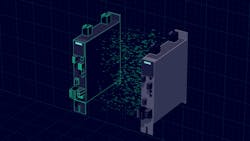
Craig Nelson, product manager, Sinamics S, Siemens Industry: The Siemens Sinamics S210 is the first digitally native servo drive, meaning it offers seamless integration into the digital workflow from concept to end of life. It is supported by a digital twin, allowing design simulation and virtual commissioning before physical installation. When in operation, data analytics and preventive maintenance are easily supported with cloud and edge integrated software. As part of its cyber resilience, including network security and User Management and Access Control (UMAC), the S210 with integrated security chip offers OPC UA connectivity with secure vertical data transfer for applications such as Syslog. Its EcoTech profile assures its digital footprint has longevity with upgradability and finally dematerialization at end of life (Figure 2).
About the Author
 Mike Bacidore
Mike Bacidore
Editor in Chief
Mike Bacidore is chief editor of Control Design and has been an integral part of the Endeavor Business Media editorial team since 2007. Previously, he was editorial director at Hughes Communications and a portfolio manager of the human resources and labor law areas at Wolters Kluwer. Bacidore holds a BA from the University of Illinois and an MBA from Lake Forest Graduate School of Management. He is an award-winning columnist, earning multiple regional and national awards from the American Society of Business Publication Editors. He may be reached at [email protected]
 Leaders Logo
Leaders relevant to this article: