How to choose the best-fit motion technology for each machine axis
Key Highlights
- Neither electric nor pneumatic motion is inherently superior; the optimal choice depends entirely on the specific position, speed, force and precision requirements of each individual axis.
- Combining electric actuators for complex, multi-position tasks with pneumatic actuators for simple two-position movements creates a cost-effective hybrid system without paying for unnecessary capabilities.
- Even when a simple pneumatic motion is sufficient, external factors like side loads and repeatability demands must guide the final selection between standard, guided or slide actuators.
There is rarely one perfect solution. Enter a destination in a navigation app, for example, and it may offer several routes. One is the fastest. Another avoids tolls. A third may be longer but more scenic. The best route depends on what matters most.
Designing motion into a machine presents the same choice of routes. Electric and pneumatic technologies can both move a load from Point A to Point B, but neither is inherently the better route. The best choice depends on what each motion must accomplish.
A case packer provides a practical example. Within a single machine, cases and products must be formed, conveyed, positioned, loaded and discharged, creating a series of different motion requirements. Following those operations through the machine shows how each requirement leads to the best-fit solution.
Case infeed
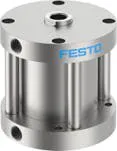
The case packing process begins at the magazine, where a flat case blank must be extracted and moved into the forming station. This short, two-position transfer takes place in tight quarters, a scenario where a compact pneumatic cylinder excels (Figure 1). Its short body conserves machine space, while pneumatics provides a substantial force in a small package. Because the motion requires only two positions, programmable positioning offers no advantage. An electric axis would add capability the application does not need.
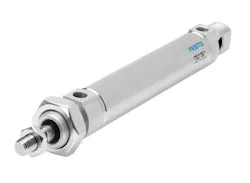
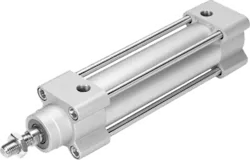
Change the requirements, and the cylinder may change. A round-body cylinder offers a slim profile and flexible mounting for medium loads and longer extensions (Figure 2). Profile or tie-rod cylinders handle higher loads and forces (Figure 3). The question remains the same: What does the motion require?
Product infeed and product collation
The erected case moves to the loading section, while bottles enter the case packer on a conveyor from a filler. Bottles arrive in a continuous stream, are organized into a pack pattern and must be moved into the open case. This motion may require multiple positions and control over acceleration, speed and stopping.
This is a different motion problem than forming the case. Product flow may have to be indexed and grouped into different pack patterns while maintaining control of the bottles as they accelerate and decelerate. The actuator is no longer simply moving between two fixed endpoints. The motion itself has become part of the process.
These requirements favor electric motion. A servo axis can move to multiple programmed positions and vary speed and acceleration throughout the stroke. That control can reduce impact, provide a gentler approach and increase force after contact.
Once electric motion is selected, the next question is how best to produce the required linear movement. Force, speed, stroke, precision, cost and operating environment help narrow the options.
Loading head
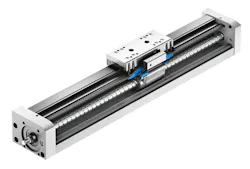
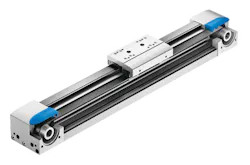
At the loading head, the grouped bottles must first move horizontally to a precise position over the open case, making an electric axis a good fit. A ball screw actuator favors precision and repeatability, while a belt actuator becomes attractive as speed and travel length increase.

The choice between a ball screw and belt therefore begins with what matters most on that axis (Table 1). If repeatable positioning drives the decision, the ball screw has the advantage (Figure 4). As travel length, speed and acceleration become more important, the balance shifts toward the belt (Figure 5). Both provide electric motion, but they solve the horizontal transfer differently.
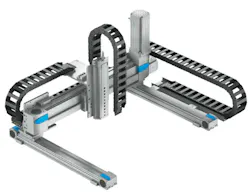
Now add a second horizontal axis. A Y-axis allows the loading head to reach different positions as case sizes or pack patterns change. That motion also requires programmable positioning, making electric motion the logical choice. Together, the X- and Y-axes form the horizontal portion of a Cartesian system.
The Z-axis presents a different requirement. It lowers the bottles into the case and returns to its starting position, making the same short down-and-up movement each cycle. That simple two-position motion can be handled efficiently by a pneumatic actuator without adding another motor to the moving assembly (Table 2).
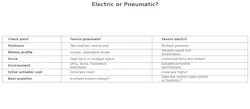
It would be easy to specify another electric axis simply because X and Y are electric. But the same selection process applies to Z. If the bottles only need to move down to the case and return, programmable positioning may provide little benefit. Pneumatics performs the required motion without adding capability the axis does not need.
The result is an X-Y-Z hybrid Cartesian system with electric X and Y axes and a pneumatic Z axis (Figure 6). This solution isn’t a compromise between electric and pneumatic motion. Each axis receives the technology best suited to the work it performs.
Case discharge
Once the bottles are loaded, the filled case moves out of the loading station on a conveyor to an accumulation line before palletizing. An automated stop is used to meter the flow of cases. The stop actuator looks like another simple pneumatic motion application. But when the heavily loaded case hits the stop, it applies force across the actuator, rather than along its direction of travel.
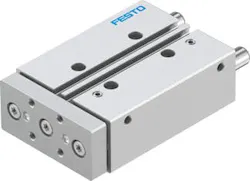
That side load changes the design. Repeated sideloading can increase deflection, wear and stress on the actuator. A guided pneumatic drive adds guide rods and bearings to absorb those forces and keep the mechanism stable (Figure 7).
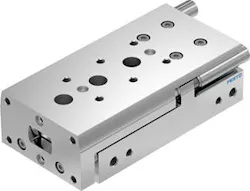
If the mechanism also requires greater repeatability, linearity and parallelism, a mini slide provides more precise guidance (Figure 8). The motion hasn't changed. The demands placed on the actuator have.
Let the motion guide the decision
The choice of the best motion technology starts with the motion, not the actuator (Table 3). Define the positions, stroke, speed, force, precision, side loads and environment. Then choose the simplest technology that satisfies those requirements without paying for capabilities the application does not need.

About the Author
 Frank Langro
Festo
Frank Langro is director, product market management, at Festo. Contact him at [email protected].