Engineering motor requirements for high-speed applications
Key Highlights
- Exceeding 5,000 to 10,000 rpm shifts motion control from simple off-the-shelf component selection to complex, customized engineering where tolerances tighten and minor imbalances can cause catastrophic failures.
- High-speed permanent magnet motors act as generators when slowing down, requiring active cooling, braking resistors, or mechanical braking systems to safely dissipate or recover large amounts of electrical and thermal energy.
- Operating at ultra-high speeds increases feedback signal frequencies, electrical noise and commutation rates, demanding high-frequency drives, advanced shielding and often slotless motor designs to maintain stable, smooth operation.
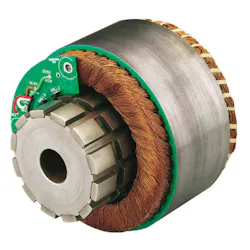
In most motion control applications, specifying a motor is a relatively straightforward exercise once the application requirements are understood. Servo and stepper motors operating in the 0–5,000 rpm range are widely available as standard, off-the-shelf products. With proper sizing and integration, they deliver predictable performance without requiring extensive customization.
However, once application requirements begin to exceed 5,000 rpm, and especially beyond 10,000 rpm, things change. At these speeds, high-performance motion control is no longer just about selecting a motor from a catalog. It becomes an engineering challenge. In many cases, systems operating in this range require significantly more customization to properly control motion, manage energy, balance loads, dissipate heat and ensure the structural integrity of the entire system (Figure 1).
Heat and power management
High-speed operation typically requires higher voltage to overcome back electromotive force (back EMF) inside the motor. It is also common to require higher current to generate sufficient torque to accelerate to speed. At these elevated power levels, passive air cooling is often insufficient to prevent the motor from overheating, making active water and/or glycol cooling systems necessary.
Drives also generate more heat that must be dissipated, particularly during deceleration. As a high-speed permanent magnet motor decelerates, it behaves like a generator, converting stored rotational energy back into electrical energy. If that energy does not have a properly defined and sized path, it can flow into unintended areas and cause catastrophic damage.
In larger systems with sufficient budget, this energy can be recovered. If recovery is not practical or economical, braking resistors or independent mechanical braking systems are used to safely dissipate the energy, typically as heat. At high speeds, a deceleration strategy must be deliberate as leaving energy flow unmanaged can result in drive failure or worse.
Kinetic energy
As rotational speed increases, the kinetic energy in the system increases and angular momentum becomes harder to control. At these high speeds, even the slightest imbalance generates increasingly large forces throughout the system. Motor poles are energized sequentially to generate rotation. If the drive cannot switch power quickly and accurately enough between poles, the motor will not maintain stable operation at high speeds. This places emphasis on switching frequency, update rates and pulse-width modulation (PWM) control in the drive.
Instability at high speed poses serious risks to equipment and safety. The margin for error decreases dramatically as rpm increases. Instability can result from unbalanced payloads, rotor imbalance or even misalignment in couplings. Even minor imbalances can quickly escalate into severe issues. A common analogy is an unbalanced ceiling fan: at low speeds it may be tolerable, but at high speeds it becomes increasingly dangerous.
Precision manufacturing
Because balance is critical, high-speed motors require higher precision manufacturing to ensure all rotating components are properly balanced. This includes the rotor, payload, bearings and couplings. Components must also be more durable to withstand the stresses of high-speed operation.
Bearings and lubricants must be selected not only for load capacity, but also for their ability to operate at elevated speeds and temperatures. Lubrication becomes increasingly important, as higher rotational speeds generate more heat and accelerate wear. In some applications, lubricants are even filtered to extend bearing life and prevent premature failure.
Structural components may also require reinforcement. The shaft or spindle often must be strengthened or upsized to handle the mechanical stresses associated with high-speed rotation. The forces involved demand more robust construction.
Get your subscription to Control Design’s daily newsletter.
For permanent magnet motors, magnet retention becomes a critical design consideration. At very high rpm, centrifugal forces acting on rotor-mounted magnets can be substantial. If not properly secured, magnets can detach under load, leading to catastrophic failure. Proper retention is essential for both safety and performance.
Slotted vs. slotless designs
Motor topology also plays a role in high-speed performance. Many servo motors use a slotted design, where windings are placed within slots in the stator. These designs typically offer higher torque density but introduce cogging—small torque variations as the rotor moves between magnetic poles.
At moderate speeds, cogging may not be significant. However, at higher speeds, minimizing torque ripple becomes increasingly important for smooth operation and stability.
Slotless motor designs eliminate cogging. While slotted motors can still be used in high-speed applications, slotless designs are often preferred when smoothness and very high rpm capability are required.
Standard products can sometimes reach speeds around 7,500 rpm, depending on the design. Beyond that, customization is often necessary to achieve the required balance, control and durability.
Faster feedback
Control complexity increases with speed. High-speed motors rely on feedback devices, such as encoders, to monitor shaft position. The drive uses this feedback to properly energize motor poles in sequence.
As rpm increases, the frequency of the feedback signal increases proportionally. For example, an encoder producing 4,000 pulses per revolution generates a manageable signal at 1,000 rpm, but at 10,000 rpm, the pulse rate increases tenfold. If the drive cannot process this signal fast enough, incorrect commutation may occur, leading to instability and degraded performance.
High-speed systems require both sensors and drives capable of operating at significantly higher frequencies. The entire control architecture must scale accordingly.
Drive electronics must also switch current between poles smoothly. At very fine resolution, some drives exhibit stepping artifacts during commutation. Minimizing these effects at high speeds requires advanced control techniques and filtering.
Shielding
Higher power levels and faster switching frequencies increase electrical noise. This noise can interfere with low-voltage feedback signals if not properly managed.
To mitigate this, high-speed systems often incorporate enhanced shielding and electromagnetic interference (EMI) mitigation techniques. Maintaining signal integrity is critical, as corrupted feedback signals can lead directly to improper commutation and instability.
System-level engineering
High-speed motor applications are not defined by a single component. The entire system must be engineered as an integrated solution, combining precision mechanical design, advanced electronics and effective energy management.
While off-the-shelf solutions can often meet requirements up to 5,000 rpm, and sometimes up to 7,500 rpm, applications beyond that range typically require highly engineered systems. As speed increases, tolerances tighten, control systems become more sophisticated, cooling becomes essential, and minor issues can escalate into catastrophic failures.
For engineers evaluating ultra-high-speed applications, success depends on system-level expertise. Partnering with experienced engineers in high-speed motion control can help ensure performance and reliability are designed in from the beginning.
About the Author
 Bruce Ng
Bruce Ng
Valin
Bruce Ng is an applications engineer, automation products, at Valin, a subsidiary of Graybar. Valin serves the technology, energy, life sciences, natural resources and transportation industries. For 50 years, it has offered personalized order management, on-site field support, comprehensive training and applied expert engineering services.
 Leaders Logo
Leaders relevant to this article: