Back to the future: why pneumatics still matter
Key Highlights
- While modern automation trends lean toward high-tech servos and steppers, pneumatics offer a sensible, efficient and cost-effective solution for applications that do not require breakneck speeds.
- Although modern components have technologically advanced since the 1980s, the foundational engineering practices and versatile capabilities of pneumatics remain exactly the same as they were 50 years ago.
- Pneumatic versatility is achieved by utilizing directional, flow and pressure control valves, which can be actuated electrically, pneumatically or manually to handle complex machine movements.
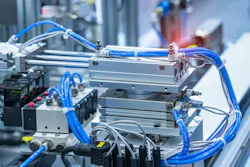
The world of automation gets faster every day, or it seems to, and the control designs that support technology move along at an ever-faster pace. There is a trend toward servos, steppers and micro-steppers, but lost in the shuffle is the fact that not everything needs to move at breakneck speed. Using high-tech components in these slower applications just doesn’t make sense. So where do we turn? The solution reveals itself in the techniques we used before all that technology came along. Pneumatics may be the answer we are looking for.
Pneumatics have come a long way from the versions I recall on packaging equipment in the late 1980s. In one example, there was a long bank of valves on a vertical packaging machine, often called a bagger, that was so large that a special plate was constructed as part of the framing of the bagger. The bank stretched all the way across the 48-inch width of the machine. The valves were large bore and could be field-serviced to swap out components. Large bore means large hoses connecting the valve to the driven devices. Relative speed was achieved by shifting a large volume of air. For this reason, machines of this design often had a built-in accumulator to store sufficient air in close proximity to the need or required the end user to use larger pipes to bring air from the compressor to the machine on the production floor.
The accumulator was often essential, especially if the air use was far from the air source. Oftentimes, the air compressor could be in a completely different part of the facility. With each line or process relying on air from the same source, those items nearer to the end of line could suffer from insufficient volume of air to correctly shift the valve body when the solenoid was activated. Furthermore, if many machines all need to shift air at the same time, some devices may not react in an expected period of time, causing crashes or missed events like product blowoff.
This example is not exclusive. Most machine designs of that era leaned heavily into pneumatics, and it made sense. Using the same solenoid valve, the designer could use a variety of different actuators to accomplish both linear and rotary movement. Combining types of actuators, we could even accomplish compound movements. Anything from opening a bag before dispensing product or ejecting a finished case out of a case packer can be achieved with pneumatics.
Get your subscription to Control Design’s daily newsletter.
Valves come in a variety of types to perform specific functions. The main types are directional control, flow control and pressure control. As the names suggest, the three types influence the direction of an actuator, the flow of air during that function and the pressure of the air passed through a particular path.
Directional valves can be two- or three-position. Two-position valves can have two, three, four or five ports through which air is directed. With two positions, the valve is in one position or the other, depending on the solenoids controlling it. A three-position valve adds a third position in the center, providing a way for a cylinder/actuator to stop mid-stroke.
Flow control valves manage the speed of the cylinder/actuator. These can come as a needle valve for precise regulation of flow rate, quick exhaust to rapidly release air on the opposite side of a cylinder/actuator and a check valve, which limits air flow to one direction only.
Pressure control valves, or regulators, maintain consistent outlet pressure regardless of the pressure at the inlet side of the valve. This is important where there might be fluctuations in pressure upstream of a critical valve or actuator.
Finally, valves can be actuated by three methods. The most common is an electrical solenoid that moves the valve spool. Another method uses air to move the valve. This might be used where the volume of air—size of valve body—is larger than a conventional valve. A smaller solenoid activates a smaller air circuit that, in turn, activates the larger valve. The third method of operating a valve is by manual means. One might encounter this with a hand or foot pedal or a lever.
The point of reviewing the above is that all that knowledge is the same today as it was 50 years ago. The difference comes in the improvement in technology of the components that make up a pneumatic system today. Design practices from way back then are just as relevant now.
About the Author
 Rick Rice
Rick Rice
Contributing Editor
Rick Rice is a controls engineer at Trew Automation, a material handling manufacturer based in West Chester, Ohio. With over 38 years’ experience in the field of automation, Rice has designed and programmed everything from automotive assembly, robots, palletizing and depalletizing equipment, conveyors and forming machines for the plastics industry but most of his career has focused on OEM in the packaging machinery industry with a focus on R&D for custom applications.