What is the future of the single-discipline engineer?
Key Highlights
- The engineering model is shifting from isolated specialization to stack thinking, requiring modern engineers to coordinate AI, robotics and additive manufacturing as a single, cohesive system.
- The convergence of these technologies enables instruction-driven, low-volume lights-out production, allowing smaller shops to achieve automation capabilities historically reserved for massive OEMs.
- Agility beats scale in this new landscape, giving small and mid-sized manufacturers a structural advantage to iterate quickly, test new tools on legacy equipment and capture market opportunities faster than large, slow-moving competitors.
 TOM KELLY
TOM KELLY
AUTOMATION ALLEY
AI & Smart Automation, Automation Systems, Design, & Integration
Tom Kelly, CEO of Automation Alley, will present "The Software-First Factory: How Automation and AI Are Rewriting the Rules of Manufacturing" at 8:00 a.m. on June 22, during A3’s Automate 2026 in Chicago.
Kelly will explore how the convergence of AI, robotics and additive manufacturing is reshaping the engineering disciplines that built modern manufacturing. He will share examples of how smaller manufacturers are using this convergence to compete with capital-intensive incumbents and what it means for engineers whose roles are shifting from single-discipline specialists to orchestrators of integrated systems.
For decades, an engineer at a small manufacturer could specialize in one discipline and build a successful career on it. I came out of school as an electrical engineer. I knew almost nothing about chemical or mechanical engineering, and I didn’t need to. That model is breaking.
Artificial intelligence (AI), autonomous robotics and additive manufacturing are converging on the shop floor. Each is advancing on its own steep curve, and all three engineering disciplines must increasingly work together in a single system. An engineer who understands AI but not additive isn’t equipped for what’s coming. The discipline boundaries that defined manufacturing engineering for the past 50 years are dissolving.
What this means for the engineer’s job
Programmers used to be paid well because they knew how to write code. That career is changing in front of us. The programmers who continue to thrive are the ones who have moved up a level. They’ve gone from writing one program a month to managing AI agents that write thousands of programs a month, and the human role is to verify intent, validate output and orchestrate the result.
Manufacturing engineering is heading the same direction. Specialization in one discipline will continue to add value, but it’s no longer sufficient on its own. The engineer who can coordinate AI, robotics and additive as one system, and who uses AI as a working co-pilot rather than an occasional tool, will define the next generation of manufacturing capability. Everyone in this field will spend part of their week managing AI-based agents the way they used to manage human collaborators.
The fear I hear from engineers at smaller manufacturers is that they can’t keep up with all of it. Nobody can. The skills that matter now are knowing how to use AI to extend what you already know and to learn what you don’t.
Treat the stack as one system
AI, robotics and additive manufacturing are converging into a new digital stack that could fundamentally reshape the traditional automotive supply chain.
AI is the brain. It interprets requirements, optimizes designs and guides decisions that engineers used to make manually. Robotics is the operator. It executes physical tasks with increasing autonomy and decreasing programming overhead. Additive is the production mechanism. It turns digital instructions into physical parts with minimal tooling and almost no setup time.
The shift this enables is from process-driven to instruction-driven manufacturing. Engineers can define an outcome and let the system determine the path to it. That has direct implications for control system design because the control logic has to coordinate across all three layers rather than optimize within one of them.
Stack thinking applies even when the equipment on the floor is decades old. TubeCo, a steel tubing manufacturer in Warren, Michigan, runs machines that in some cases predate World War II. With the help of a state grant, the company added low-cost sensors, data-capture tools and AI-driven analysis to existing equipment without replacing any of it.
The result was better visibility into processes that had been opaque and equipment that now meets the data and traceability requirements of large automotive customers.
Lights-out at low volume changes the math
True lights-out manufacturing, sometimes called dark-factory production, remains rare. The fully unattended plants in operation today are concentrated at the top of the capital and volume spectrum, in a small number of plants globally and clustered in industries like semiconductors, electronics assembly and high-volume consumer goods. That model still works for the largest operators and isn't going away.
The smaller-scale version of the same idea is becoming reachable for the rest of manufacturing. Lights-out behavior at low volume runs on parts of one rather than parts of 1 million. Decisions that used to require human intervention now happen inside the system.
Get your subscription to Control Design’s daily newsletter.
The mechanical setup is unglamorous on purpose. A robot tending a 3D printer is one of the most trivial use cases in the entire field of robotics. The robot reaches into the build chamber, removes the finished part, clears the build plate and starts the next job. Pair that simple task with an AI-driven design and queueing system, and you have continuous low-volume production with minimal human oversight. The result is a small-shop version of what only the largest operators have historically been able to build.
At Air & Liquid Systems, the shift to additive manufacturing started with a single part (Figure 1). The industrial fluid handling supplier needed a machined coupling that cost more than $100 per unit and had to be sourced externally. Engineers tested whether the part could be printed in-house and validated it through real-world stress testing. The printed version came in at just over a dollar.
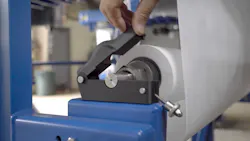
The example highlights a broader shift happening across manufacturing. Additive manufacturing is not simply a cheaper production method; it changes how companies approach design, testing and production.
Why this environment favors faster shops
Speed is becoming the dominant competitive variable in manufacturing, and speed favors smaller organizations more often than scale does.
Larger manufacturers have legitimate reasons to move slowly. They have more to lose. They have legacy systems that can’t be torn out without affecting active customer programs. They have decision layers and risk-management processes that exist precisely because the consequences of a bad call at scale are severe. None of that is irrational. It also makes them structurally slow to adopt new technology, even when the technology is mature.
Smaller manufacturers can experiment. They can put a 3D printer on the floor next to a CNC and see what gets made. They can deploy sensors on legacy equipment and try AI-based analysis without convening a steering committee. When the underlying technology is changing every six months, the ability to iterate quickly compounds. The advantage in this environment goes to the swift rather than to the capital-intensive.
Opportunities that were historically available only at OEMs are starting to flow toward smaller shops with the right technical capability.
Where this leaves smaller manufacturers
All of this means that the future of automation looks more like a redistribution of capability toward whoever can adopt the new stack fastest than a consolidation toward the largest players.
For engineers and owners at small and mid-sized manufacturers, the first steps aren’t complicated. Bring AI tools into everyday workflows so the team builds fluency. Identify one process where sensors and data capture would surface what’s currently invisible. Find a small, low-volume part that could be printed rather than machined. Treat each as a learning exercise rather than a transformation program.
The companies that will benefit are the ones whose engineers are willing to treat the convergence as a single problem rather than three separate ones. The answer to whether there is room for the small in the future of automation is “yes,” but only for those willing to claim it.
About the Author
 Tom Kelly
Tom Kelly
Automation Alley
Tom Kelly has been CEO and executive director at Automation Alley in Troy, Michigan, since 2016. Automation Alley is Michigan’s Digital Transformation Insight Center, a nonprofit technology business association whose mission is to accelerate the growth and global competitiveness of businesses through Industry 4.0 technologies and innovation. Kelly leads the strategic vision, financials and operations of Automation Alley and subsidiaries, including Project DIAMOnD and the U.S. Center for Advanced Manufacturing. Kelly launched Project DIAMOnD, a $28 million initiative creating the nation’s largest distributed 3D printing network for over 350 small manufacturers, and he elevated Automation Alley to World Economic Forum status as the U.S. Center for Advanced Manufacturing, positioning Michigan as a global smart manufacturing hub. Under Kelly's leadership, Automation Alley membership expanded from 750 to over 4,000 manufacturers, tech firms, academics and government partners. Kelly holds a bachelor of science degree in electrical engineering from Clarkson University and a master of business administration degree from University of Michigan. Contact him at [email protected].
 Leaders Logo
Leaders relevant to this article: