Top tips for upgrading your safety system
Designing or upgrading machine safety systems can be a daunting task, with confusing regional and industry-specific safety standards to contend with, not to mention corporate interpretations and additions that extend beyond the minimum standards. Additionally, many existing safety systems from only a few years ago are complex systems of special relays with parallel hardwiring, which provide no fault diagnostics and little feedback about specific conditions that caused a failsafe condition.
Today, safety systems have evolved to embrace digital communication with improved diagnostics, topology flexibility, simple connection technology, ease of installation and maintenance, and improved performance and uptime. Read on to discover how to implement or upgrade your safety system today.
1. Determine the safety levels require for your application.
Ensuring applicable machine safety standards are met is key to any robust safety implementation and is a necessary first step in the safety development process.
The International Electrotechnical Commission (IEC) 62061 standard defines safety integrity levels (SILs) between 1 and 3, and the International Organization for Standards (ISO) 13849-1 standard defines safety performance levels (PLs) between A and E. ISO standards tend to be more general, whereas the IEC standards are more technical. The actual safety standards you will need to follow depend on your industry, the global region where the equipment will be installed, and corporate safety guidelines.
2. Realize the benefits of configurable safety products for initial setup, logic modifications, and diagnostics.
Configurable safety products allow the user to create and modify the safety logic without having to change the wiring of safety relays, as was done in the past. Not only does the end user save time and money by not having to do time-consuming wiring or source expensive hardware safety relays, but modifications to the safety logic can be done offline, tested, certified, and then launched on multiple identical systems, minimizing the downtime of multiple factory lines.
3. Integrate your safety system with providers of industry-leading automation controllers for improved operator information and less engineering, maintenance, and operational training.
Using complementary and compatible safety gateways and devices with industry-leading automation controllers expands the market presence of available safety peripherals suitable for a given factory system. Likely, the engineering staff already has some experience with these prevalent automation controllers, not to mention the high availability of third-party complementary products. This makes developing a complete system, from general automation to safety devices, much simpler without having to use multiple communication systems to do so.
4. Consider the benefits of a scalable safety system.
A modular, scalable safety system can streamline machine development and reduce installation time and costs, especially when a family of different sizes and complexities of the same machine design is conceptualized. Using a standard Ethernet-based fieldbus in combination with an underlying safety interface, such as ASi, allows for seamless scalability. By building on the consistency of a scalable architecture, the safety system can be easily extended or adapted, reducing engineering effort and avoiding the need to reinvent the wheel with each new system design or request. Similarly, the operator interface can be scaled by utilizing programming function blocks as machine components or complete assemblies in the programming environment. This helps keep continuity within a family of machines (Figure 1).
5. Recognize that a simplified wiring solution has huge benefits.
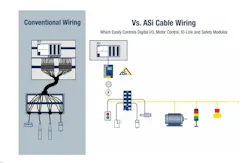
Replacing hard-wired safety relays with an industry-proven wiring system for standard and safety signals reduces the number of cables, terminations, and failure points in an industrial system. This has a major impact on hardware and labor costs, commissioning time, improved diagnostics, and downtime reduction.
6. Future-proof your system by using an open, standardized safety protocol with an equally open fieldbus.
Open industrial safety communication protocols allow for multi-vendor support, increased acceptance in multiple industries, and more advancements and improvements to the standard from a variety of industrial fields. This helps ensure that the technology remains relevant in the future and helps drive innovations and advancements that are backward compatible, meaning that the risk of obsolescence is minimized.
While any industrial Ethernet protocol can serve as the supervisory level, incorporating a secondary safety protocol such as ASi Safety can significantly reduce the cost of safety system integration. ASi Safety helps reduce Ethernet bandwidth consumption by handling safety communication through a more cost-effective medium, while still transmitting safety information to your preferred PLC. By deploying a widely supported safety protocol like ASi Safety over industrial Ethernet, you ensure compatibility with evolving safety standards and preserve the long-term value of both your core automation systems and safety architecture.
7. Explore more about integrated safety gateway products from an industry leader in safety, such as Bihl+Wiedemann.
Designing or upgrading a safety system can be challenging. It is always a best practice to consult with an experienced company with a great history of assisting customers with implementing quality safety solutions. Bihl+Wiedemann, a member of the Rockwell PartnerNetwork, assists customers by taking the complexity out of safety systems and providing tailor-made solutions for various industries and application areas, ranging from functional safety, ASi, IO-Link, IIoT, and Industry 4.0 to conveyor and warehousing systems. They can provide guidance and support to assist you with your safety system.
For more information, visit https://www.bihl-wiedemann.de/us/applications/functional-safety