A new spin on safe automatic wrappers
Key Highlights
- TAB Industries partnered with Maverick Dynamics to develop the TAB Wrapper Tornado, an orbital stretch wrapping machine designed specifically to secure and stabilize awkwardly shaped or oversized products on pallets.
- By developing Standard, Smart and Genius control levels using scalable IDEC components, the manufacturers can offer everything from a budget-friendly basic setup to a highly automated system with advanced diagnostics.
- Using devices like the FS1B safety controller eliminates the need for expensive safety PLCs and software validation, while built-in diagnostics and free global support significantly reduce machine downtime for end users.
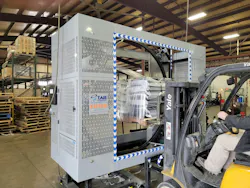
First impressions matter. Manufacturers and material handlers recognize the importance of carefully selecting the right packaging to ensure that finished products reach customers in pristine condition. Protecting materials and finished goods is not always an easy task, particularly when the products are extremely large, irregularly shaped or not well-suited for traditional square pallets.
This was a familiar challenge for TAB Industries, a family-owned manufacturer specializing in custom metal fabrication. The company faced the dilemma of securing metal doors and other unwieldy, oddly shaped objects on pallets for shipment. Their search for a solution ultimately led to the development of the TAB Wrapper Tornado, the industry leader in orbital stretch wrapping machines. Orbital wrappers secure palletized loads by automatically wrapping stretchable film over the load and under the pallet (Figure 1) and are an excellent solution for longer pallets that cannot spin on a traditional turntable. The 360° wrapping process stabilizes and protects the product by preventing shifting during transport while also eliminating the need for more labor-intensive alternatives, such as applying bands or straps.
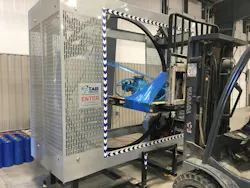
After connecting with systems integrator (SI) Maverick Dynamics at an industry trade show, the two companies partnered to develop and expand this portfolio of orbital stretch wrapping machines, which have since been deployed worldwide, by incorporating enhanced safety features and options for advanced controls in response to customer pain points.
Stretching the limits of control systems
Original equipment manufacturers (OEMs) are expected to do more with fewer resources. As a result, successful OEMs tend to take a customer-centric approach, focusing on customer preferences and behaviors. Machine designs that prioritize longevity and strong diagnostic capabilities and minimize complexity without sacrificing safety are in high demand. With this in mind, the controls architecture for this project needed to meet several key criteria, including:
- a “Standard/Smart/Genius” feature set range tailored to the application
- advanced diagnostics capabilities
- reliable, long-term global vendor support
- superior safety integration
- scalability, in terms of functionality and addressing customer needs.
As an SI, working with OEMs offers the opportunity to develop new products and innovations that can reshape entire markets. Because OEMs frequently encounter similar operational challenges, understanding these pain points is crucial when selecting technologies and options that can deliver meaningful impact.
One platform, multiple possibilities
Recognizing that wrapping needs can vary significantly across applications, a tiered approach was desired to tailor solutions to meet the diverse needs of the OEM and its end users. This strategy allows for a cost-effective entry-level solution while also offering full-featured systems capable of supporting demanding applications with intensive duty cycles. Of course, every product would incorporate indispensable safety and operator-centric features.
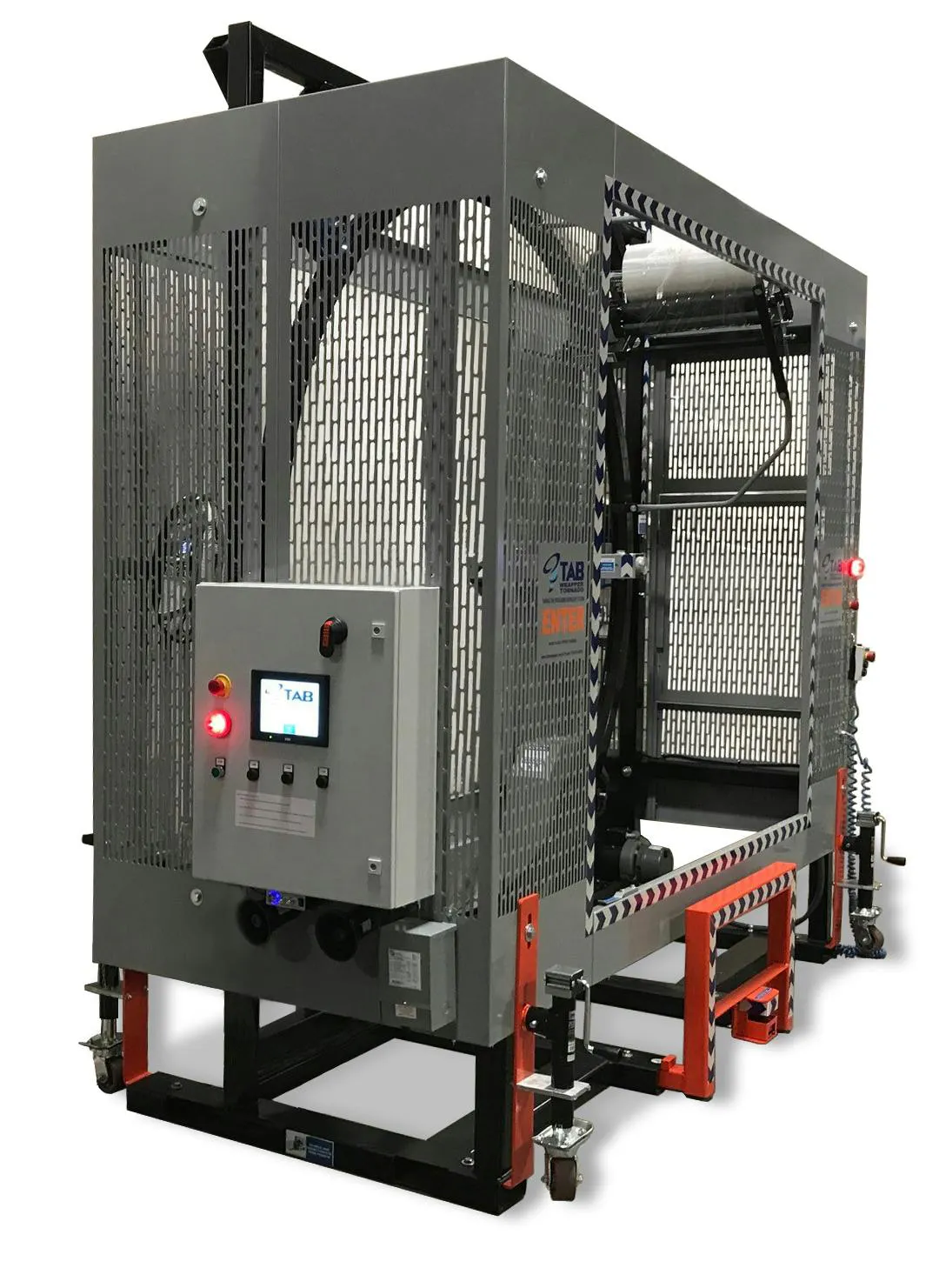
Three levels of controls were developed for the orbital wrapper—Standard, Smart and Genius—with each offering increased functionality while maintaining high safety standards (Figure 2). To support this scalable architecture, IDEC was selected as the automation vendor. With a comprehensive automation and safety portfolio, IDEC is recognized for delivering not only the latest technology, but also exceptional customer-centric and long-term global support. Unlike many vendors that phase out legacy products, IDEC continues to support even its first-generation controllers—an important advantage for OEMs managing long equipment lifecycles.
Standard controls
The controls for the entry-level “standard” orbital wrapper feature a single-phase across-the-line starter and basic hardwiring. There are many end users whose requirements are satisfied by this reliable and straightforward approach. However, other customers need additional options, so more advanced versions were developed.
Smart controls
The intermediate Smart control system replaces the starter with a variable frequency drive (VFD) featuring onboard logic to automate the machine’s wrapping and cutting functions. An IDEC HR6S series safety relay, in conjunction with an FS1B safety controller, manage all safety functions, providing options for satisfying machine safety ratings up to Category 4 and Performance Level (PL) e. The DIN-rail mountable safety devices operate in parallel to the automation circuit and interfaces with safety features and safety pull cords.
The FS1B safety controller manages inputs from emergency stop (e-stop) switches, and up to four SE2L laser safety scanners used to detect the presence of people or objects in pre-defined zones and connected using output signal switching device (OSSD) signals. The FS1B safety controller oversees the automation system, able to initiate the safe torque off (STO) option in the VFD, immediately removing power from the drive output without interrupting control power, if necessary. Additionally, it prevents the system from starting when unsafe conditions are detected. The FS1B safety controller is flexible enough to integrate with a wide range of third-party drives, and the system can easily be customized to accommodate end-user VFD preferences (Figure 3).
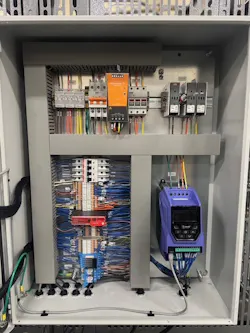
Perhaps the key advantage of using the FS1B safety controller for this application is that it utilizes pre-certified safety logic, which is configured via a series of DIP switches. This approach satisfies a key customer need by eliminating the need for an expensive and complicated safety programmable logic controller (PLC) platform. As a result, complexity is significantly reduced for both the configuration and certification of safety functions, since there is no software requiring validation or audit. Set up can be completed in a matter of minutes, without the need for third-party validation. This provides a highly effective, efficient solution for cost-sensitive OEM applications.
Get your subscription to Control Design’s daily newsletter.
Genius controls
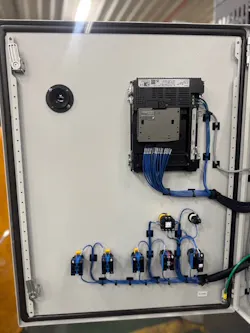
The fully automated and customizable Genius level controls incorporate even more functionality by adding an FC6A MicroSmart PLC to the mix along with a HG3G-V8 high-performance human machine interface (HMI). The FC6A PLC enables highly customized features and integration of barcode scanning, lift and rotate tables, label applicators and load measurement systems into the automated storage and retrieval system (ASRS), and specialized wrapping sequences. VFD data and diagnostics, such as voltage, current and error codes, are also captured to support wrapper operating and maintenance efforts.
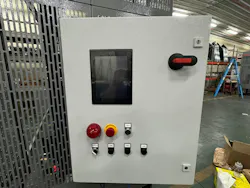
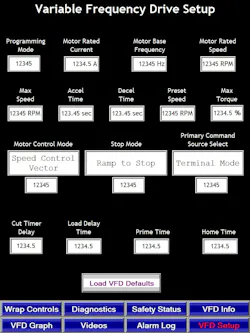
The HMI is installed on the machine control panel in portrait mode, providing colorful touchscreen controls (Figure 4) offering instant visibility to configuration settings, operation data and diagnostic information from the orbital wrapper. The HMI features a fully developed script editor. Using this feature, I/O from the VFD is mapped directly to the HMI via Modbus, bypassing the need for interposing PLC configuration.
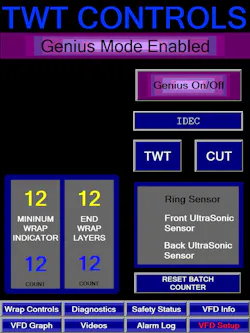
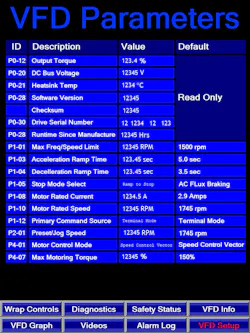
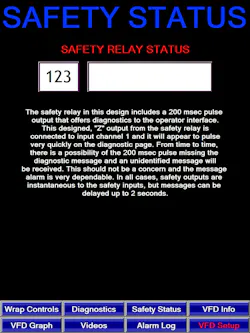
Similarly, using the high-speed 200 millisecond Z1 pulse output from the safety relay, a subroutine was developed to translate error messages from the safety relay to the HMI screen. This logic was generated purely with HMI scripting and did not require PLC software. The HMI outputs can also be used to drive light towers or other visual indicators, which are often utilized with the Genius controls.
With a minimal, one-time cost, the WindO/I-NV4 HMI software is provided for the life of the product. This approach is valued by SIs, OEMs and end users in all regions of the world, as it removes the burden and expense of managing ongoing software licensing fees. The HMI development software is user friendly with a drag-and-drop interface, extensive symbol library and support for more than 100 communication protocols, making it quick to generate advanced graphics.
Empowering users with exceptional support
With more than 2,000 machines in the field and 150 new systems deployed each year, a robust training and diagnostics system was developed to support all types of users. TAB Industries created the TAB Wrapper University, an extensive collection of video training and step-by-step instructions to empower end users and distributors. Accessible anytime from anywhere in the world, it empowers operators to adjust the machine without the need to call in specialists, resolving a key pain point for many customers. Utilizing these resources makes troubleshooting and maintenance tasks quick and easy, with very little downtime.
Detailed fault information is readily accessible to users, with comprehensive manuals that reference specific error codes tied to components such as the SE2L safety laser scanner and FS1B safety relay. These resources guide users through common issues, such as cleaning a safety scanner lens, inspecting photoeyes or identifying mechanical damage, which enables faster resolution and minimizes downtime.
The IDEC controls platform provides robust onboard diagnostics that allow most issues to be quickly identified and resolved without the need for remote access. In fact, remote connectivity has only been required a handful of times over the past decade, underscoring the effectiveness of the system’s built-in diagnostic capabilities.
Equally important is the availability of responsive technical support. IDEC offers free global telephone support, with knowledgeable staff who assist users in efficiently diagnosing and resolving issues.
Preparing for the future
The integration of artificial intelligence (AI) and data with machine automation is still considered the “undiscovered country.” With vast amounts of data available, the challenge is no longer accessing data, but rather using it to drive customer-centric, meaningful results.
As industry continues to evolve, the ability to seamlessly integrate AI-driven analytics with machine-level controls is poised to become a competitive advantage for system integrators and OEMs that find a way to minimize the complexity. Solutions built on established, scalable global platforms, such as those offered by IDEC, provide a proven record of long-term usability and support users as they move forward and adopt changing technologies.
About the Author
 Len Crawford
Len Crawford
Maverick Dynamics
Len Crawford is the founder of Maverick Dynamics, a systems integration firm in Harrisburg, Pennsylvania. With a background in electrical construction and mechanical design, Crawford is dedicated to providing efficient solutions for his clients. He holds a bachelor of science degree in electrical engineering from Penn State University.
 Leaders Logo
Leaders relevant to this article: