Acoustic and capacitive 3D sensors make their presence felt at Automate
Key Highlights
- Emerging technologies at the Automate Show highlighted a strong industry shift toward protecting human workers using 3D spatial awareness zones rather than traditional flat 2D planes.
- Sonair has developed the first independently verified 3D safety sensor to achieve SIL 2 and PLd compliance using ultrasound instead of light, providing a robust backup where vision-based cameras fall short.
- By mounting directly to a robotic arm's flange, the Hexopus capacitive sensor creates a dynamic, spherical safety zone that eliminates the need for bulky external safety infrastructure.
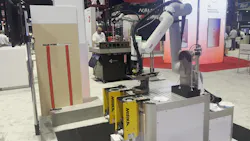
The Automate Show, hosted by the Association for Advancing Automation, was filled with a variety of automation spanning machine control, motion and sensing. One of the more interesting developments was the number of technologies put to use for sensing the presence of individuals in three-dimensional (3D) zones.
Two of those, Sonair’s ADAR One sensor and AuraSensae’s Hexopus, drew particular attention.
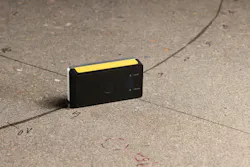
Sonair’s ADAR One sensor, which uses acoustic detection and ranging (ADAR) technology, is now suitable for SIL2 and PL d applications and is certified to fulfil all requirements of the European machine directive as a sensor for the safe detection of humans and objects (Figure 1).
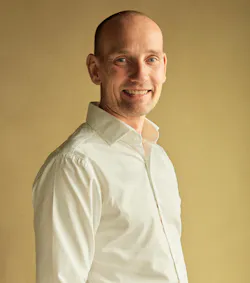
"The bottleneck to safe human-robot coexistence isn't intelligence or speed,” said Knut Sandven, CEO of Sonair (Figure 2). “It's safe perception; knowing reliably under any condition, that a human is nearby. This milestone certification is the first time a 3D sensor has been independently verified to meet that bar using sound instead of light, a new sensing modality that complements cameras where they fall short.”
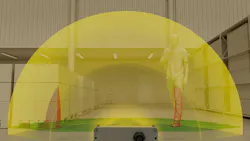
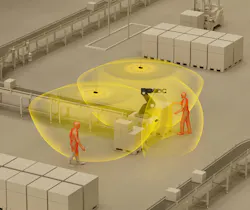
Designed for autonomous mobile robots and industrial automation, ADAR One is designed to deliver 180°-by-180° 3D spatial awareness, detecting people and obstacles at all heights (Figure 3).
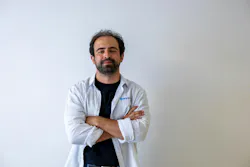
AuraSensae is an Italian company specializing in advanced safety for industrial environments. "We develop innovative capacitive sensors and intelligent algorithms that can precisely detect human presence in real time,” explained Javier del Rio Martin, operations and business developer at AuraSensae (Figure 4). “These technologies are designed to create reactive and adaptive systems that enhance safety and facilitate more natural, seamless human-machine collaboration. Our mission centers on transforming industrial safety by enabling responsive, flexible and smart human-machine interactions."
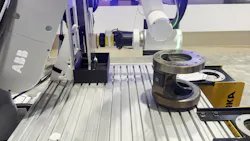
Hexopus represents AuraSensae's answer for human-robot collaboration environments. "It is a smart safety device that transforms robots into human-aware systems, detecting workers in real time and creating an invisible, localized, dynamic safety zone,” said del Rio Martin (Figure 5). “Hexopus is an enabling technology for robotics and collaborative environments. By removing barriers while enhancing protection, it allows manufacturers to unlock the full potential of their collaborative robot investments, achieving higher productivity, greater flexibility and improved safety simultaneously."
Acoustic detection and ranging
“ADAR One does not merely replace a sensor,” said Sandven. “It introduces a new safety layer for robotics, a certified 3D perceptual foundation that sits beneath any camera, AI stack or motion system, independently verifying that the space around a robot is safe.”
ADAR One is already in series production and shipping on deployed industrial robots. Since the introduction of the beta version of ADAR one year ago, more than 80 robotics companies have evaluated ADAR through Sonair's test program (Figure 6).
ADAR was also the winner of LogiMat's Best Product award in the category of Identification, Cargo Securement and Packaging and Loading Technology.
Get your subscription to Control Design’s daily newsletter.
BeRobox, a plug-and-play palletizing and de-palletizing provider, has entered into an agreement with Sonair to deploy the safety-certified ADAR One sensor in future offerings. "At beRobox, innovation is not just about developing new products,” explained David Demers, CEO of beRobox. “It's about continuously integrating the best technologies available to simplify automation for our customers. Partnering with Sonair is another step in our mission to stay ahead through innovation and deliver the most advanced, user-friendly palletizing and depalletizing solutions on the market.”
ADAR One was assessed as a human protection sensor according to the IEC 61496 standard for electrosensitive protection devices. In addition, the product meets two foundational standards: IEC 61508, the functional safety standard for electronic safety systems in high-risk industrial environments, and ISO 13849, the universal standard for safety-related parts of control systems.
ADAR is rated safety integrity level 2 (SIL 2) and performance level d (PLd) with a probability of dangerous failure (PFH) below 1.5 x 10⁻7 per hour.
ADAR has received an EC type-examination certificate from exida, a notified body under the Machinery Directive 2006/42/EC. In addition to the above-mentioned standards, exida has assessed ADAR’s conformity to the essential health and safety requirements from the European machine directive (Figure 7).
Furthermore, ADAR is the first safety-certified embedded system to be built in Rust, a programming language especially designed for performance, safety and reliability, according to Sonair.
“This is precisely the role ADAR One is designed to play as a drop-in, pre-certified safety layer,” said Sandven. “What used to be an engineering burden is now transformed into a commercial differentiator for all stakeholders.”
3D capacitive sensing
AuraSensae’s Hexopus capacitive sensor enables fence-free and flexible production layouts by transforming proximity sensing into deployable industrial safety to enable closer, safer human-machine interaction.
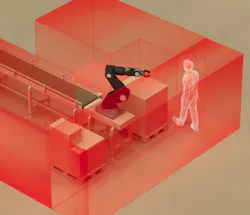
The sensor attaches around the end of the robotic arm and creates a spherical detection zone that can be extended up to 2 m (Figure 8). To be sold as safety devices in the European market, AuraSensae capacitive sensors are required to have a Notified Body certificate, which is issued by a government-designated organization. "We're now pursuing certification targeting PLd, Cat. 3, with respect to ISO 13849-1, and SIL 2, with respect to IEC 61508,” explained del Rio Martin. “Commercialization of safety devices requires an EC examination from a notified body, in our case, with respect to Machinery Directive 2006/42/EC, Annex IX, Module B. We are currently working with them for closing the certification path and to receive the Declaration of Conformity."
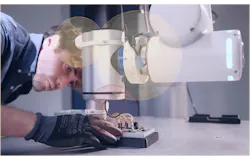
AuraSensae is working with different consultants for the certification, in particular for testing activities and functional safety requirements, in order to receive certifications for selling the system in both the EU and U.S. markets, del Rio Martin noted.
For mounting purposes, Hexopus is installed on the robot flange between the robot arm and the end effector (Figure 9). "This on-robot approach eliminates the need for external infrastructure while providing protection exactly where it's needed—around the hazard zone created by the robot's end effector. Hexopus makes any tool collaborative, simplifying the risk assessment of the application,” said del Rio Martin.
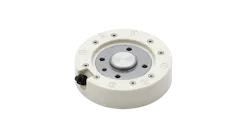
"The system is brand new,” he continued. “In 2026 we've been doing proof of concept and pilots in different environments. We've installed it in automotive environments with positive feedback from the customer."
Automate was AuraSensae’s America launch, while it was launched in Europe during Hannover Messe in April. “The system is brand-agnostic but has exclusivity on ABB Robotics," explained del Rio Martin.
Coverage from the show floor
About the Author
 Mike Bacidore
Mike Bacidore
Editor in Chief
Mike Bacidore is chief editor of Control Design and has been an integral part of the Endeavor Business Media editorial team since 2007. Previously, he was editorial director at Hughes Communications and a portfolio manager of the human resources and labor law areas at Wolters Kluwer. Bacidore holds a BA from the University of Illinois and an MBA from Lake Forest Graduate School of Management. He is an award-winning columnist, earning multiple regional and national awards from the American Society of Business Publication Editors. He may be reached at [email protected]
 Leaders Logo
Leaders relevant to this article: