Fundamentals of proximity sensors: inductive vs. capacitive vs. PIR
Key Highlights
- Proximity sensors offer superior durability and speed compared to mechanical switches because they eliminate physical wear and tear during detection.
- Choosing the right sensor depends on the target material, with inductive sensors being best for metals, capacitive for non-metals or liquids and PIR for human motion detection.
- Specific sensors, like the inductive type, provide high immunity to industrial contaminants like oil and dust, ensuring consistent performance in demanding factory conditions.
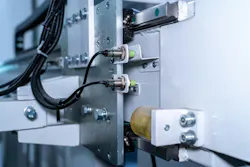
My first exposure to proximity switches was after college as a design-and-build engineer at a fiber optics plant. The switches were end-of-travel and home switches on linear slides of a production machine. I then noticed that they were being used for door-lock indication, speed detection of flywheels and gears and many other use cases throughout the different manufacturing lines.
Whether these sensors are used for position detection as on the gantries, for detecting parts for assembly or for innumerable other cases, the use of non-contact presence sensors has been a mainstay of industrial controls since the development of the first versions in the 1950s.
Unlike mechanical switches, proximity sensors detect the presence or absence of an object without physical contact, which reduces wear, improves reliability and allows for faster operation. Among the most widely used proximity sensing technologies in industrial environments are inductive, capacitive and passive infrared (PIR) sensors. Each operates on a different physical principle, and each is best-suited to particular applications.
Inductive proximity sensors
Inductive proximity sensors are the most common type used in industrial automation, particularly in metalworking and assembly operations. These sensors operate by generating an electromagnetic field from a coil inside the sensor. When a metal object enters this field, eddy currents are induced in the metal, which causes a change in the oscillator amplitude within the sensor. The sensor detects this change and switches its output state. Because this sensing method relies on electromagnetic interaction with conductive materials, inductive sensors are ideal for detecting metals such as steel, aluminum, brass and copper.
The primary advantage of inductive sensors is their durability. They are largely immune to dust, dirt, oil and moisture, making them ideal for harsh factory environments such as machining centers, stamping presses and conveyor systems handling metal parts. They are commonly used for position sensing, counting parts, detecting gear teeth and confirming the presence of metal components in fixtures. However, their main limitations are that they can only detect metal and that their sensing range is relatively short, typically a few millimeters to a few centimeters depending on sensor size and target material.
Capacitive proximity sensors
Alternately, capacitive proximity sensors operate on a different principle. Instead of detecting metal through electromagnetic induction, capacitive sensors detect changes in capacitance caused by the presence of almost any material. The sensor forms an electrostatic field between the sensing face and the environment. When an object enters this field, the capacitance changes because the dielectric constant of the object differs from that of air. This allows capacitive sensors to detect a wide range of materials, including plastics, glass, wood, paper, powders, liquids and granular materials.
This versatility makes capacitive sensors particularly useful in packaging, food processing, plastics manufacturing and material handling applications. They are often used for level detection in bins and tanks, especially for liquids or bulk solids. For example, a capacitive sensor mounted on the outside of a plastic tank can detect the level of liquid inside without ever contacting the material. The trade-off, however, is that capacitive sensors are more sensitive to environmental conditions such as humidity, temperature and material buildup on the sensor face. Proper setup and sensitivity adjustment are critical to prevent false triggering.
Get your subscription to Control Design’s daily newsletter.
Passive infrared sensors
Lastly, passive infrared sensors, commonly referred to as PIR sensors, operate on yet another principle: the detection of infrared radiation emitted by objects, particularly warm objects like human bodies. PIR sensors do not emit energy; instead, they detect changes in infrared radiation levels within their field of view. When a person or warm object moves across the sensor’s detection zones, the sensor detects the change in infrared energy and triggers an output.
In factory automation, PIR sensors are most commonly used for motion detection, safety systems, lighting control and energy management, rather than precise part detection. For example, they can be used to turn on lighting in rarely used areas, detect personnel entering restricted zones or signal that an operator is present at a workstation. They are not typically used for detecting stationary objects or for precise positioning because they rely on motion and temperature differences to function.
How to choose
When selecting a proximity sensor for an automation application, the decision often comes down to material type, sensing distance, environmental conditions and cost. Inductive sensors are usually the best choice for metal detection in harsh environments due to their ruggedness and reliability. Capacitive sensors are the best option when non-metal materials must be detected or when level sensing is required. PIR sensors are best-suited for detecting human presence or motion, rather than parts.
In the end, proximity sensors are a widely used and very adaptable component of factory automation systems. Understanding how each sensing technology works, and where each performs best, allows engineers, technicians and purchasing teams to select the right sensor for the job, improving reliability, reducing downtime and ensuring consistent production performance.
About the Author
 Joey Stubbs
Joey Stubbs
contributing editor
Joey Stubbs is a former Navy nuclear technician, holds a BSEE from the University of South Carolina, was a development engineer in the fiber optics industry and is the former head of the EtherCAT Technology group in North America.
 Leaders Logo
Leaders relevant to this article: