From vision sensors to autonomous quality systems
Key Highlights
- Machine vision is shifting from a passive pass/fail gatekeeper to an active participant in closed-loop control, using real-time data to adjust upstream processes and prevent defects before they occur.
- The transition from rigid, deterministic rules to deep learning models allows systems to handle high-mix production and complex visual defects by learning from data rather than requiring constant manual reprogramming.
- By moving high-performance AI processing to the edge, vision systems achieve the millisecond-level latency necessary for tight integration with robotics and high-speed motion control.
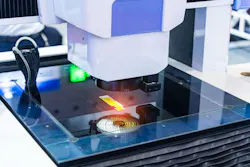
Machine vision has long been used in factory automation for quality inspections, the final checkpoint separating acceptable parts from the rework pile or the scrap bin. For years, that role was defined by deterministic tools such as edge detection, contrast thresholds and carefully tuned rule sets that performed well in stable environments. Today, vision systems are no longer just inspectors. They are becoming adaptive, data-driven participants in the manufacturing process, capable of influencing outcomes rather than simply recording them.
At the center of this transformation is the rise of artificial intelligence (AI)-driven vision. Deep learning models, once considered experimental, are now widely deployed in production. Unlike traditional systems which rely on explicitly programmed criteria, these models learn from examples. This allows them to identify subtle defects such as surface blemishes, inconsistent welds or irregular textures that are difficult to capture with fixed logic. For manufacturers dealing with high-mix production or natural material variation, this removes a long-standing limitation. Instead of repeatedly revising inspection code to accommodate new product variants, engineers can retrain models with updated datasets, allowing the system to evolve alongside the process.
This flexibility is enabling a broader change in how vision systems are used. Increasingly, they are integrated into closed-loop quality control strategies. Rather than issuing a simple pass or fail signal, modern vision platforms generate rich data streams that feed back into the control layer. A defect trend identified at the end of a line can now trigger upstream adjustments, whether compensating for tool wear, correcting alignment drift or fine-tuning process parameters in real time. In this context, vision becomes less about catching errors and more about preventing them. It acts as a continuous feedback mechanism, helping stabilize processes that could otherwise degrade over time.
Delivering this level of responsiveness depends on another key development: the migration of processing power to the edge. In the past, vision systems often relied on centralized computing resources, introducing latency and limiting scalability. Today, compact industrial PCs and embedded processors can run sophisticated AI models directly at the machine level. This reduces decision time to milliseconds and allows vision to be deployed closer to where it is needed, whether on a robot arm, a high-speed conveyor or a gantry system moving across a large work envelope. For applications that demand precise synchronization between motion and inspection, such as pick-and-place verification or in-motion surface analysis, this shift is especially significant.
Get your subscription to Control Design’s daily newsletter.
At the same time, the definition of “vision” is expanding. Traditional 2D imaging is increasingly complemented by 3D and multispectral sensing technologies. Structured light and time-of-flight systems add depth information, enabling accurate dimensional inspection and improving robotic guidance. Meanwhile, thermal and hyperspectral imaging enable detection of defects that are invisible in the standard visual spectrum, such as subsurface inconsistencies or material composition issues. By combining these data sources, modern systems can build a more complete understanding of the part under inspection, improving the reliability and accuracy of AI-driven analysis.
As these capabilities mature, vision systems are also taking on a predictive role. By analyzing defect patterns over time, AI models can identify correlations between visual anomalies and upstream process conditions. This makes it possible to anticipate failures before they occur. A gradual increase in surface defects, for example, might indicate tool degradation or contamination long before it reaches a critical threshold. When integrated with maintenance and production systems, this insight allows manufacturers to intervene proactively, reducing downtime and minimizing scrap.
Another dimension of this evolution is the growing integration between vision and robotics. Vision-guided robots are no longer limited to simple presence checks or alignment tasks. They can now perform complex inspection routines, adapting in real time to part variation and positioning uncertainty.
Underlying these trends is a shift toward modular, scalable system architectures. Manufacturers increasingly seek solutions that can be reconfigured as production needs change. This includes the ability to swap sensors, update software and redeploy vision assets across different lines or products. At the same time, the data generated by these systems is becoming a critical asset. Detailed inspection records support traceability, simplify compliance and provide a foundation for continuous improvement initiatives.
Taken together, these developments point to a more integrated nature of vision inspection. Machine vision is evolving from a standalone inspection tool into an integral component of intelligent manufacturing systems. It is moving upstream in the process, becoming faster, more flexible and more deeply connected to other elements of the automation stack. For engineers and system designers, the challenge is no longer just selecting the right camera or algorithm. It is understanding how vision can be woven into the broader control strategy to create systems that not only detect defects but actively work to eliminate them.
About the Author
 Joey Stubbs
Joey Stubbs
contributing editor
Joey Stubbs is a former Navy nuclear technician, holds a BSEE from the University of South Carolina, was a development engineer in the fiber optics industry and is the former head of the EtherCAT Technology group in North America.