Wireless sensor deployment in challenging OT environments
Key Highlights
- Complete wireless control loops rely on input transducers (sensors) to convert real-world physical phenomena into electrical signals, and output transducers (actuators) to translate digital control commands back into physical action.
- Because traditional transducers generate localized analog signals, like 4-20 mA or 0-10 V, a specialized wireless node is required to condition, scale and convert those signals into digital packets compatible with protocols like Wi-Fi, Bluetooth, Zigbee or LoRa.
- Utilizing wireless gateways in expansive or harsh OT environments, such as monitoring temperature on a large outdoor rotary cement kiln, eliminates the need for manual physical inspections by feeding real-time alarms directly to a centralized control room.
Modern operational technology (OT) uses wireless networks regularly to interface the physical world and the digital world. Transducers make this connection possible. A transducer is a component that coverts one form of energy to another. Industrial controls capitalize on this device by utilizing the convenience of wireless in safety, remote, and environmentally challenged environments. Transducers are the first and last link in the communications chain.
A typical transducer consists of a sensing element, transduction element, signal conditioning circuitry, output stage, power supply and protective housing. Combining these components into a device allows engineers to convert physical phenomena into usable electrical signals for monitoring or control systems. There are two types of transducers. The types are based on function. Input transducers are considered sensors. Output transducers are called actuators.
![Figure 1: Pressure → [Diaphragm] → [Strain Gauge] → [Amplifier] → [4–20 mA Output].](https://img.controldesign.com/files/base/ebm/controldesign/image/2026/07/6a454a7505c3123de46a8783-transducer.png?auto=format,compress&fit=max&q=45)
The signal is created when a physical stimulus produces a correlated, proportional electrical output. Then the signal will traverse the airways and find its way inputted into a PLC and likely a PID loop. If not, maybe it’s just going to get used in a historian for trending so that people can use the data to make decisions.
Output transducers are known as actuators. The actuator converts an electrical signal into physical action. Motors turn on when levels get too low or too high. Blow off valves open when pressures are greater than the norm. Alarms sound when a gas is monitored in the air. Actuators are associated with action. The thought process is that sensors gather information, and actuators influence the change of environment. Both sensors and actuators are needed for a control loop to function.
Get your subscription to Control Design’s daily newsletter.
A wireless node is also required. Transducer analog signals are suitable for short distances but are not compatible with wireless digital communications. Wireless nodes convert analog signals to digital signals via conditioning and scaling, using an analog to digital component, and some kind of packaging that fits a usable wireless protocol. Common wireless protocols are Wi-Fi, Bluetooth, Zigbee and LoRa. Sensors send data to the node, the node converts the signal, and then the signal is sent to a gateway or cloud to be monitored, analyzed or stored.
If this conversion process did not occur, wireless monitoring of physical conditions would not be possible. Transducers are essential components in wireless environments. Wireless systems allow seamless interaction between physical environments and digital systems. Input transducers (sensors) capture real-world data, while output transducers (actuators) translate digital commands into physical action. However, because many traditional transducers produce analog signals, a wireless node or transmitter is necessary to convert these signals into digital form. This conversion allows the data to be transmitted, processed and utilized within wireless networks, making modern monitoring and control systems more efficient, scalable and flexible. The ability to be flexible is what makes wireless a viable avenue in today’s operational technology world.
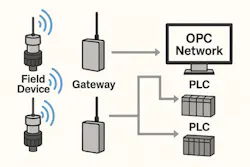
One example of a real-time wireless network that provided operational feedback to a distributed control system (DCS) is using temperature monitoring of a pyro processing system using a rotary kiln. Cement kilns are long, large and outside, so they meet the challenging environment criteria. However, wireless monitoring allows instant feedback, and a gateway allows DCS interface to the wireless network. This means alarming can occur in real time, so that if there are limited operators in the control room, they don’t have to walk a route to get information. For this reason, wireless technologies are a great addition to the operational technology environment (Figure 2).
About the Author
 Tobey Strauch
Tobey Strauch
Arconic Davenport
Tobey Strauch is currently managing brownfield installations for controls upgrades at Arconic Davenport. She has previously worked as principal controls engineer and before getting her bachelor’s in electrical engineering, was a telecommunications network technician. She has 20 plus years in automation and controls. She has commissioned systems, programmed PLCs and robots, and SCADAs, as well as managed maintenance crews. She has a broad mix of mechatronics with process control. She enjoys solving problems with Matlab and Simscape. Contact her at [email protected].
 Leaders Logo
Leaders relevant to this article: