How agentic AI turns the digital thread into action
Key Highlights
- Agentic AI can extend the digital thread beyond sharing information by allowing specialized AI agents to make decisions, initiate actions and coordinate tasks across engineering, production and supply chain.
- Manufacturers need contextualized, secure and accessible data, as well as involvement from operators and engineers, to effectively deploy AI from the front office to the factory floor.
- AI agents could transform traditionally serial engineering processes into parallel workflows by simultaneously evaluating design changes, simulations, manufacturability, costs and supply-chain requirements.

For manufacturers, the digital thread has long promised to connect information across engineering, production, supply chain and other parts of the enterprise. Agentic artificial intelligence (AI) could turn that connected information into something more powerful: a system capable not only of delivering information to people, but also of acting on it.
Rahul Garg, vice president of industrial machinery at Siemens, and Lindsay Berg, general manager, industry marketing, at Microsoft, discussed how agentic AI could transform manufacturing during a presentation focused on the agentic digital thread during the International Manufacturing Technology Show (IMTS), hosted by the Association for Manufacturing Technology (AMT) in Chicago (Figure 1).
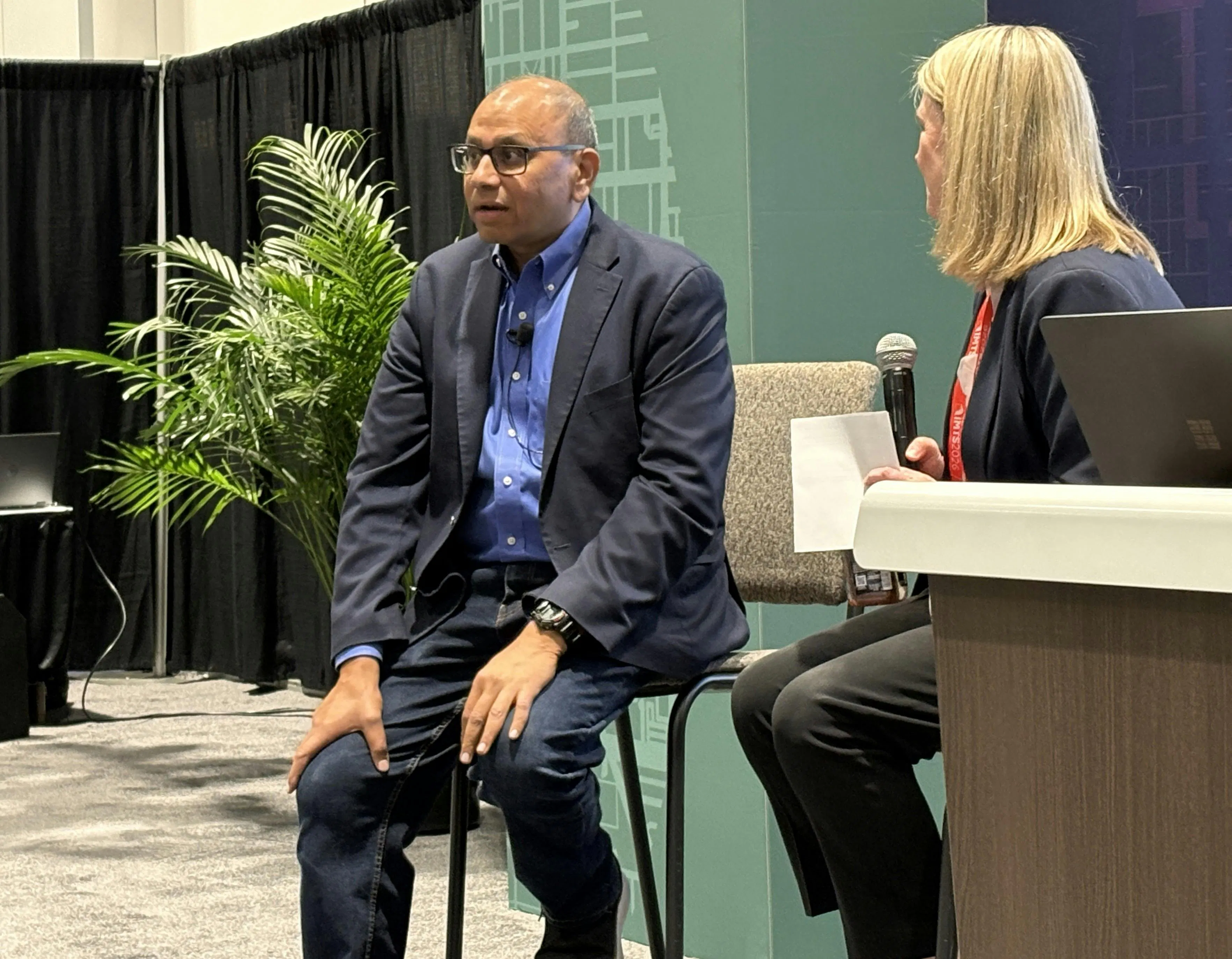
“The idea behind a digital thread is making sure that information from one group of people is available to another group of people,” Garg explained. Agentic AI, he said, takes that concept to the next level by enabling decisions and actions based on that information.
Consider a purchasing department that needs to replenish a component. A conventional digital thread could alert purchasing that inventory is running low. An AI agent could go further by contacting suppliers, gathering information about price and delivery times and helping determine which supplier could provide the required material quickly enough to keep production running.
“That’s where I think agentic AI truly makes it into an intelligent enterprise,” Garg said. Information becomes not only more readily available, but something that can be acted upon quickly.
Specialized agents working together
Garg compared the emerging agentic enterprise to a soccer team. A goalkeeper and striker have different responsibilities and skills but need awareness of what their teammates are doing. AI agents similarly can be trained to perform specialized tasks while working within a larger system.
“In an intelligent enterprise and an agentic enterprise, you’re going to have thousands of agents,” Garg predicted. Each could possess skills and capabilities appropriate to a particular task.
That makes visibility between agents critical. Berg noted that Microsoft is focusing on “observability”—the ability to see what agents are doing and understand the actions they are taking.
That visibility also underscores the importance of the digital thread. Manufacturers typically do not suffer from a lack of data, Garg explained. Their challenge is connecting and contextualizing it.
“The winners are not going to be the ones who have that data,” Garg said. “There is no shortage of data in a manufacturing company. The winners are going to be the ones who are able to pull that all together.”
Factory AI
Garg divided a manufacturing operation into three broad areas. The first includes interactions with suppliers and customers. The second encompasses factory planning, scheduling and operational management. The third is the physical factory floor itself.
AI adoption is already well underway in the first area, Garg said, including applications such as responding to requests for proposal (RFPs), requests for information (RFIs) and requests for quotation (RFQs), as well as customer service.
“If you as a business are not doing that already, you are already falling behind,” he warned.
The next opportunity is connecting customer and engineering requirements directly to production. Garg offered the example of a machine safety requirement changing from stopping a machine within 500 milliseconds after a door opens to stopping it within 300 milliseconds.
Such a change potentially affects PLC code, drives, motors and electrical requirements. An agentic digital thread could communicate the new requirement across the engineering disciplines responsible for those systems rather than relying on a series of manual handoffs.
The third area, Garg said, is physical AI—putting AI directly into machines and production processes. “That’s the next big frontier,” he said.
Deploying AI on the factory floor, however, requires winning over the people who operate and maintain equipment.
“You’ve got to make the operator comfortable,” Garg explained. “You’ve got to make sure that his job or his task is improved by bringing in these tools.”
One example is AI-assisted PLC programming. Instead of spending hours creating code from scratch, a programmer might use AI to generate much of the initial program and then concentrate on reviewing, modifying, testing and validating it.
Berg emphasized that frontline workers will continue to play a critical role because they often possess knowledge that is difficult to capture in conventional systems. Operators understand the quirks of individual machines by sight and smell and can recognize conditions that might not yet appear in machine telemetry.
Future systems could combine that human expertise with additional sound and vision sensors. A machine, for example, might begin making an unusual noise or producing smoke before its conventional telemetry identifies the problem.
Turning serial engineering into parallel engineering
The potential benefit ultimately comes down to speed, not simply making employees work faster, but eliminating delays associated with finding information and moving work from one department to another, said Garg.
One example highlighted during the presentation involved Rolls-Royce, a customer of both Siemens and Microsoft. According to a customer video shown during the presentation, digital technologies have helped Rolls-Royce connect information across design, development, testing, production and maintenance. The company reported utilization improvements of 30% on some machines and said real-time monitoring was replacing some manual inspection processes that previously took days.
Garg used an example of an aircraft-engine hydraulic pump to illustrate how agentic AI could change engineering workflows. Engineers can simulate how fluids move through a pump under different operating conditions, including the dramatically different environments experienced on the ground and at altitude.
Get your subscription to Control Design’s daily newsletter.
If a simulation identifies a problem, an engineering agent could initiate design modifications and run additional iterations. Other agents could simultaneously determine whether the redesigned component should be manufactured additively or subtractively, identify suitable machines, calculate cycle times and costs and investigate material availability from suppliers.
“All these agents can start working for you before you actually finalize the design,” Garg explained.
That changes the nature of engineering collaboration.
“One simple design change can be evaluated very effectively, very quickly by one person working closely with four other groups,” Garg said. “Otherwise, it would have taken a serial process. Now we have made it into a completely parallel process.”
Berg sees similar potential in supply-chain planning, where manufacturers increasingly need to evaluate tariffs, border issues and other changing conditions. Agents could repeatedly run what-if scenarios as circumstances change, allowing manufacturers to prepare for multiple outcomes rather than react after disruptions occur.
The criticality of context
Before manufacturers can realize that vision, they need a strong data foundation.
“You cannot just put everything into a data lake and expect everything to just work,” Garg warned.
Instead, data needs context. An AI system needs to distinguish, for example, between a customer requirement, product-design information and machine telemetry. Garg pointed to product lifecycle management (PLM) technology as one way of preserving those relationships and providing engineering context.
Security must accompany that contextualization. Manufacturers need to control how internal information is accessed, as well as what data suppliers and other partners can see.
Berg noted that agentic architectures might offer another option when organizations cannot or do not want to combine data. Separate agents can operate on different data sets and interact with one another while the underlying data remains separated.
For manufacturers with little centralized production data, data collection is effectively “Step Zero,” said Garg. “If you haven’t collected any data so far, if you haven’t managed your data, you will need to start that journey,” he said.
Berg added that the data often already exists but remains trapped locally within machines. Manufacturers can begin by extracting sensor data into a local repository where it can be analyzed, even if moving everything to a cloud environment is not yet practical.
From digital thread to autonomous manufacturing
Siemens and Microsoft see their respective capabilities as complementary. Microsoft provides scalable computing, AI and data-processing infrastructure, while Siemens contributes manufacturing-domain knowledge and engineering context.
“We all bring a lot of scalability, a lot of intelligence, a lot of data-processing strengths, and we bring the manufacturing domain expertise,” Garg said.
The result could be a digital thread that no longer simply records what happened during engineering and production. Instead, agents could use that thread to identify problems, initiate actions, evaluate alternatives and connect decisions across engineering, manufacturing and supply chain.
Garg believes the industry is still near the beginning of that transformation, estimating manufacturers have explored perhaps 5% of what AI eventually could make possible. Physical AI, robotics and humanoid technologies could accelerate the change further.
He compared the transition to the arrival of the Internet and smartphones, but he also expects adoption to happen much faster this time. “What took 10 years is going to happen in three years,” Garg predicted.
For manufacturers, that suggests the digital thread is evolving from a means of connecting data into a foundation for connecting decisions. The next competitive advantage may come not from possessing more information, but from giving engineers, operators and intelligent agents the context to understand it, as well as the ability to act on it.
About the Author
 Mike Bacidore
Mike Bacidore
Editor in Chief
Mike Bacidore is chief editor of Control Design and has been an integral part of the Endeavor Business Media editorial team since 2007. Previously, he was editorial director at Hughes Communications and a portfolio manager of the human resources and labor law areas at Wolters Kluwer. Bacidore holds a BA from the University of Illinois and an MBA from Lake Forest Graduate School of Management. He is an award-winning columnist, earning multiple regional and national awards from the American Society of Business Publication Editors. He may be reached at [email protected]
 Leaders Logo
Leaders relevant to this article: