Human in the loop: Teaching tomorrow's engineers to leverage and audit AI design tools
Key Highlights
- Purdue University is partnering with Eplan to break down traditional engineering silos and give students a holistic understanding of how to integrate the bill of materials (BoM) with advanced technologies like machine learning and automation.
- While vertical AI tools promise valuable efficiency boosts during the front-end design stage, their results must still be treated with caution in high-reliability controls environments where human accountability and a clear audit trail remain essential.
- To build the critical auditing skills necessary for managing AI tools, engineering students must be taught through open-ended problems that force them to navigate uncertainty, make independent assessments and confidently defend their technical decisions.
Next-generation tools are empowering designers and developers in many ways, especially as support from artificial intelligence (AI) is being added to expand functionality. How do we best address how to teach the tools?
This year’s Eplan Next26 took place in a completely new event format, serving as a global festival for visionaries, decision makers and users worldwide. With the motto “Where Industry Meets Tomorrow,” Eplan recently took place at Cavalluna Park in Munich with more than 1,200 participants, including component manufacturers, machine manufacturers, operators and experts from various sectors, uniting to address the future of industrial automation and engineering.
Among the luminaries at the event was Dr. Grant Richards, assistant professor of practice at the Department of Engineering Technology at Purdue University. We talked about Eplan, its impact on the industry and its importance to the next generation of engineers. Eplan is a provider of development software for electrical engineering, enabling machine and panel builders, along with their suppliers, to design automation and power systems more effectively. Eplan provides access to millions of ready-to-use device data sets and engineering templates designed to speed up engineering, integrating with a range of engineering tools, enterprise resource planning (ERP), product data management (PDM) and product lifecycle management (PLM) systems, integrating the ecosystem of project partners and clients.
What brings you to Eplan Next26 here in Munich?

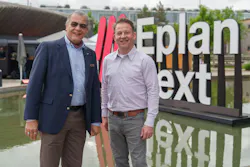
Dr. Grant Richards, assistant professor of practice at the Department of Engineering Technology at Purdue University: I’m here because we are entering a new partnership with Eplan and bringing it into our curriculum and our research areas (Figure 1). At Purdue, we concentrate on working with industry and bringing solutions to industry and also bringing the latest technology into our classroom and our curriculum. The partnership with Eplan is a very important piece of that as we look at exposing our students to technologies that really are transforming the market. We want to make sure that they are capable and aware of what those potential technologies can bring, and Eplan represents a really advanced technology in its space. The significant aspect I would say is the competency that we would expect our students to gain as they are entering the marketplace.
Let's be a little bit more specific. How do you see Eplan helping your students in this competency area? How do you expect them to use Eplan? What are the tool competencies you feel they're going to get out of that?
Dr. Grant Richards, Purdue University: Purdue is a very large university in terms of the number of students that move through our programs, and we don't focus on one particular market sector within the industry. We focus broadly because our students really do go everywhere within the United States and globally, as well. One of the core challenges of advancing industry at this moment is establishing that cohesive thread from the initial design and the bill of materials all the way through the most advanced systems, including machine learning and AI. Having a technology that helps bridge the gap and keeps those pieces together really allows for those students to go in and start to take what were silos within an automation environment and start to move those forward and allow for more advanced technologies to be implemented within the space. So it really is a facilitation and integration platform that we look at from the terms of a curriculum.
We cannot necessarily teach too many specifics of any general industry, so we need to make sure that they have a holistic understanding of where all of the technologies that could be put in place within a particular environment exist. And then, how to bridge those technologies to get a new solution.
When we talk about the marketplace, there is a saying: “There's many a slip ‘twixt the cup and the lip.” For example, you’ve got the bill of materials (BoM), and you want to make sure that everything in that BoM is correct. Now there are a lot of various tools and solutions currently being used to address design and BoM development. What makes Eplan more useful to your people than, say, some other program?
Dr. Grant Richards, Purdue University: It's the integration with the largest vendors in the market. It's the data portal that allows for the ease of access to that data. Anything that reduces the barrier to the design process and the integration process is going to be a very useful tool. In the market, that is just one of the challenges we have. Are there too many new technologies that are out there? It's very hard to make somebody an expert in all of these technologies. Any tool that can help bridge that and allow for these connections to be more natural is going to be very helpful.
Get your subscription to Control Design’s daily newsletter.
Our students are not going to come in and essentially fill out one specific slot within an industry. They are going to look broadly across the available technologies and assess the capabilities of the given context that they're in. They will find those natural, efficient fits where a technology will bring some value without heavy lifting. So having tools that will help bring these different technologies together and ease that process is very important to the role that we're positioning them for in the market.
They've introduced quite a few innovations within the Eplan system, like the copilot, for example, their AI tool. What are your feelings on the use of AI tools in that sense, in a tool of that nature?
Dr. Grant Richards, Purdue University: I think it's very promising and hopeful. There's still uncertainty about where the value proposition is and the confidence in the AI responses. Anything that's 80 to 85% effective is not really something that's considered a great fit in the controls market. But at the front end of the design stage, it can help ease some of the barriers in the challenging spaces where we need that extreme level of reliability, so I think it will help with the efficiency. It sounds promising. I'm excited about what could be possible.
For the record, I'm a big advocate for AI tools, and this is a good example of vertical AI. I have high confidence that it will fulfill what is needed, because it's not trying to write your term paper for you, do you know what I mean?
Dr. Grant Richards, Purdue University: Yes, when we look at it in our curriculum, AI is a tool, and it would be remiss to ignore it. Where you can bring it in, of course, ultimately, a human has to be responsible for the output that it produces. So that's how we position AI in our curriculum right now. You shouldn't avoid it; you should utilize it. But you should also take great care when you are using AI and definitely have a good audit trail for the results that are produced.
That brings up one of the big questions in my mind when it comes to AI and AI tools. Yes, these tools will help these students become better within the design team in implementing engineering solutions and making sure the BoM is done. But the other side is that you want a human expert in the loop. How do these students develop that secondary expertise to be able to understand whether or not the AI is doing what it's supposed to be doing?
Dr. Grant Richards, Purdue University: That is the challenging part of the education process. When we look at education within our institution, we are purposely putting them in a situation where they are going to have to make a lot of assessments. We start with training, but in the very small sense, we really bring open-ended problems in, and part of this problem-solving process that we introduce them to is getting them comfortable with realizing they will have to grow their own skills and capabilities before they can have that confidence that the results that they're getting are valid.
So we purposely put them in scenarios where they have to make decisions in their uncertainties. And then they have to back the decisions that they make, and if they can't back the decisions that they make, then they should not be making those decisions. You need an educated workforce. You can have the greatest technologies. You can have the greatest products, but if you don't have a pool of capable, trained users, it's not very marketable.