Combine 3D imaging tools with engineering principles for better design
Key Highlights
- While 3D laser scanning and digital twins are powerful tools for visualizing complex plant geometries, they are supplements to, not replacements for, critical engineering analysis and site verification.
- The primary risk of relying solely on high-fidelity imaging is the loss of human context, such as operator workarounds, maintenance access needs and environmental variables that data points alone cannot capture.
- True project efficiency is found by combining data-driven tools with traditional engineering principles to ensure that digital simulations actually align with physical reality.
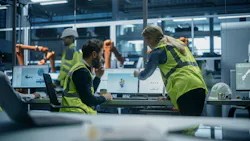
There is a growing trend to use laser scanning to create 3D images of the plant floor, of machine locations and of intricate areas that are congested with plant infrastructure to allow integrators to visualize how they can install new equipment or modify old equipment.
What can machine builders use 3D imaging for?
- documentation of complex geometries
- plant layout
- current fixture attachments
- piping and instrumentation paths
- tray and conduit paths
- fixture and bracket staging and measurement.
High-fidelity scanning can get millimeter cloud points and allow for documented measurements. Inside the plant, it could be used to update drawings that have been left out of change cycles when the plant maintenance had to change things based on an emergency or some other urgent factor.
Digital twins are the other factor. 3D automation of plant components has been in play for a while now with Autodesk AutoCAD Plant 3D, Aveva E3D Design, Hexagon Intergraph Smart 3D, Siemens Tecnomatix Plant Simulation X tiers and others. The list is long.
So, is it worth the time and the cost?
Is it worth the complacency?
If construction engineers take site visits for granted and use the software to make decisions, what are the risks? It comes down to attention to detail. We, as engineers, still must inspect and verify. Thus, the engineer is displacing attention to detail with how well the tech who comes to site can capture what’s needed for design or digital-twin rendering.
It is a tool. Thus, like any tool, the risk is dependent on how well you can use it and apply the data to the outcome that you need. The adage: trust, but verify.
Why? In the rush to save time and do more, quality must be considered. This is the fear with all the technology doodads that are on the market. If the tool is considered a shortcut, then it is not necessarily a time saver because then the plant engineer installing the design will get stuck with the difference between simulation and reality. “But,” you say, “this measures real material.” It does. Understood.
But how many people using it have the industrial engineering theory and the context of the machine? One of the biggest issues in installing new equipment is the differences in perspective.
A machine engineer can whip up some drawings and copy and paste everything that worked last time, and then an electrician can come in and destroy the plan due to small things like, cooling, spacing to get drive isolation transformers out for maintenance; or maybe the HVAC guys want a shell and tube condenser instead of a typical HVAC unit because plant water has stuff in it not good for HVAC filtration. Or, on a job in Iceland, the PID loop that’s normally used doesn’t work because of geothermal water. Or the person who put the drain in the roof inadvertently put it right over the location of your control cabinet, after it falls on the control room, rolls off, hits piping and floods the front of your panel.
Or safety can walk buy and demand you put the gate back because Bob comes through here with his tug twice a day during the third week in October due to inventory and he got hurt one year. We cannot have that.
Get your subscription to Control Design’s daily newsletter.
Hmm. What is the point? If engineers give up agency to technology, then the critical thinking is lost. The quality of design is depleted, and the costs go up instead of down. Thus, is time really saved? It can be, but keep the technology in context as a tool to help. The analysis and context of design still must be analyzed. What people leave out of the AI and machine learning models is context and the human conversation, and the human condition.
What is the difference? For brownfield, it is the difference between an upgrade of components and an improvement to get the machine back to an efficiency that was valued when the system was newer. For greenfield projects, it’s absolutely crucial to show where a machine can go and demonstrate to the customer how it will look and behave. The analysis with the customer and the operations and the context of the machine is the 50 years of people making it work. Operators create workarounds because stuff broke or because it’s easier.
Are 3D imaging tools handy? Yes. In moments, you can capture where a machine component fits and look at space on the floor and get measurements usable for design. Clash detection and constructability can be analyzed. Workflows can be analyzed. Geospatial analysis allows for plant layouts and flows to be respected.
All of it is true, but only if the engineer takes it, analyzes it and then meets to validate what is found in the context of what the customer needs, what safety needs, what operations needs, what maintenance needs and what finance will cover. The push to be data-driven is not the issue. The push to ignore the need for accurate drawings and documentation of the decisions made based on the data is the issue.
It may be considered “old school” to look at a sheet of paper instead of an application, but the drawings from the 1980s are more accurate in most cases, or at least have more detail. Why? Less assumptions were made and no one was copying and pasting. We still need traditional engineering principles to stay, but use the new technologies to reduce the ambiguity and risk.
About the Author
 Tobey Strauch
Tobey Strauch
Arconic Davenport
Tobey Strauch is currently managing brownfield installations for controls upgrades at Arconic Davenport. She has previously worked as principal controls engineer and before getting her bachelor’s in electrical engineering, was a telecommunications network technician. She has 20 plus years in automation and controls. She has commissioned systems, programmed PLCs and robots, and SCADAs, as well as managed maintenance crews. She has a broad mix of mechatronics with process control. She enjoys solving problems with Matlab and Simscape. Contact her at [email protected].