Key Highlights
- Effective stepper motor selection depends on mechanical requirements like torque, resolution and move profiles rather than just an understanding of internal magnetic physics.
- The choice between hybrid, permanent magnet and variable reluctance motors allows engineers to balance cost against the need for precision and high-speed performance.
- While stepper motors can operate in open-loop systems without feedback, adding an encoder enables closed-loop control to prevent stalls and achieve higher torque at increased speeds.
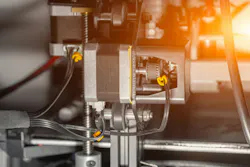
Control systems use stepper motors in various applications, and controls engineers might have to replace a stepper motor in the field. Understanding how a stepper motor works and how it causes motion can be advantageous if the controls engineer needs to specify a motor for replacement or specify one for an application.
Stepper motors can have two to five phases. Typically, stepper motors have two phases. The motor will have two separate windings, and there is one phase per winding. The motor is considered bipolar or unipolar. One way to think about it is that it can go from left to right, up or down and forward or back.
The motor will have a rotor with teeth. The rotor is split into parts and separated by a magnet. Half of the teeth will be considered one region, and half the other. For directional purposes, one half will be north poles, and the other half south poles. The stator of the motor will have a higher number of equivalent poles with a smaller pitch like 360°/teeth pitch. The relationship between the number of rotor poles and the equivalent stator poles and the number of phases and full step angle can be derived mathematically, with the assumption that the rotor and stator tooth pitch is equal.
Step Angle = 360/(NPh/Ph) = 360/N
NPh describes the equivalent poles per phase and number of rotor poles. Ph is the phase number. N is the total number of poles for all phases together.
Is it necessary to know this as a controls engineer choosing a motor for an application? No. The engineer who designed it might like to talk about it though. What does a controls person need to know to choose a stepper motor?
To specify a stepper motor, the controls engineer should consider the driving mechanism and required components to be specified for the wanted outcome. This means determining how far something needs to move and the positioning required in the period. Then the resolution needed should be determined. Is gearing required for the said resolution?
Next, determine the type of profile for the moves needed. How much acceleration torque is needed, and what operating pulse speed will obtain this? Calculate the required torque to move the load that is moving. Select a motor for that load requirement. Check the selected motor based on acceleration rate/deceleration rate and inertia ratio. All these factors are controlled by understanding motor torque, resolution and position accuracy and motor size.
Too big of a motor will cause chatter or waste energy. If it’s too small, the load requirement will not be met.
Get your subscription to Control Design’s daily newsletter.
Other considerations are what type of stepper motors are available, and which one is best for the application needed. Choices are variable reluctance, permanent magnet and hybrid. Hybrid motors provide better performance with respect to step resolution, torque and speed. Permanent magnet motors may be best for a “bang-bang” type application, and they cost less. Variable reluctance motors literally put a dc voltage across the poles, and, when they become magnetized, it causes movement. The rotation occurs when the teeth are pulled to the energized stator poles.
Where can you find stepper motors in industry? Stepper motors are used in 3D printers, CNC machines, robotics, medical equipment, scanners, belt conveyors, sewing machines and laser cutters, to name a few. Stepper motors are chosen due to costs and because they offer precision and repeatability.
Do you need to know how the inside of a stepper motor works to choose the proper one for your application? Not necessarily, but understanding basics might help understand the application the motor is used in.
For instance, stepper motors do not require encoders, but they do require a drive. A stepper drive is used to provide the power to sequence power to the windings to create the magnetic field that causes the pulses that make the rotation occur.
Encoders are optional if an application requires position feedback, but the encoder is not needed for the position to be maintained. Closed-loop control requires an encoder and can prevent stalls or achieve a higher torque at higher speeds. Open-loop control on CNC units does not require encoders. Why? Because a missed step is not detrimental to the process. The alternative to a stepper motor is a servo, but there are added costs. Hopefully, this brief introduction to stepper motors gives insight into how stepper motors work, how to specify one and where they are used in industry.
About the Author
 Tobey Strauch
Tobey Strauch
Arconic Davenport
Tobey Strauch is currently managing brownfield installations for controls upgrades at Arconic Davenport. She has previously worked as principal controls engineer and before getting her bachelor’s in electrical engineering, was a telecommunications network technician. She has 20 plus years in automation and controls. She has commissioned systems, programmed PLCs and robots, and SCADAs, as well as managed maintenance crews. She has a broad mix of mechatronics with process control. She enjoys solving problems with Matlab and Simscape. Contact her at [email protected].
 Leaders Logo
Leaders relevant to this article: