When can you run a motor in overload status?
Key Highlights
- Running a motor at 175% load increases I2R heating losses to approximately three times the normal level, pushing the hardware well beyond its thermal design limits and violating NEMA MG 1 standards.
- Every 10 °C rise above a motor’s design temperature effectively cuts the lifespan of its insulation in half, leading to premature winding failure, ground faults and potential fire hazards.
- While ac motors with VFDs can mimic dc motor performance by delivering 200% to 300% torque, these overloads must be strictly limited to short-time duties (such as IEC S2 or S3) to allow for critical cool-down periods.
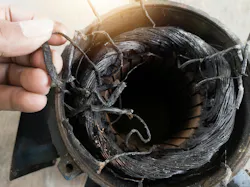
What if a specification says that the customer wants the motor to be run at “175% continuous”?
What does that mean? Sometimes motors can run at 175% of their rated load continuously, but the conditions should be specified within boundaries of the system. What running a motor at 175% continuously means is that the current load expected ≈ 175% FLA or torque ≈ 175% rated torque. This means losses (I2R heating) ≈ 3 x normal. That pushes the motor well beyond its thermal design limits.
When might this happen? Certain applications may require that a motor runs at an overload condition for the application. However, it’s usually timed and limited to a specific period, so that the heat output can be compensated for.
Industrial motors are typically rated and built to specified service conditions. Per NEMA MG 1, motors are not designed for continuous operation above nameplate rating. IEC 60034 specifies that continuous overload beyond rating leads to insulation life reduction or failure.
Thus, when should a motor be allowed to run in an overload condition?
Special conditions may warrant motor overload conditions. This would be non-continuous short time duties or if the motor is doing minimum work for its size, special purpose or severe deratings.
This includes short-time duty, not continuous, such as crane, hoist, mill or press drives, or motors that have high overload allowed for seconds or minutes, followed by cool-down, so that the thermal properties of overloading are accounted for. This also includes motor duty types, such as IEC S2, S3 or S6.
Oversized motors doing small work may be overloaded if 175% is relative to process demand but still ≤ motor thermal rating. This is rare and often misunderstood. However, dc motors may allow for this.
Special-purpose motors with specific purposes may have inverters or specialized torque functions. Such functions requiring inverter-duty or torque motors use winding specifically rated for high continuous torque, or the motor is configured to allow for the high torque function. It’s uncommon to see where the nameplate explicitly allows over-duty cycles.
Severe derating often occurs when the motor massively oversized thermally, where there is improved cooling, lower ambient, reduced voltage stress so that the motor can handle the load, or if there is compensation for the insulation life span. However, even then, insulation life is usually compromised.
What kind of compromises are expected when motors are overloaded? Motor windings will overheat. Insulation will deteriorate. Trip overloads will occur. Bearings will become damaged. Warranties will not be adhered to, and safety becomes a factor. Why? Overheated, overloaded circuits cause fires or strange machine behavior. Also, it costs money. Every 10 °C rise above design temperature cuts insulation life roughly in half.
What is an example of a motor that can handle an overload? Large manufacturing applications typically use dc motors instead of ac motors because dc motors can outshine ac motors when a high starting torque is required, when frequent overloads are expected, when the low-speed torque matters or when the load is cyclic. Think about a rolling ball mill and when the load shifts.
Modern ac motors are taking over some of this dc functionality by using vector-controlled variable-frequency drives (VFDs) and permanent magnet ac servos. These types of systems can mimic dc motor overload behavior and retain ac motor robustness, as well as delivering 200% to 300% torque for a brief period.
Should you push the limits? No. Motors are still regulated by their thermal capacity. Ratings must be adhered to for overload capacity, and the limiting factor to this is the thermal limit related to windings, environments and materials. How the motor is used counts, as well.
If you are changing out motors often, it’s beneficial to look at the application, the electrical feed, noise on the power system and the motor ratings, as well as the environment the motor is in. Dust and debris and harsh conditions can starve a motor of capacity, as well. Overcurrent, overload damage, voltage imbalances, poor grounding, frequent start stops and winding shorts and ground faults will cause motor failures, also. Inaccurate sizing will cause chronic overheating. Operating above the motor service factor and inadequate cooling will decrease motor life, also. Poor lubrication of bearings is another factor. Duty-class choice is important, too. Vibration can destroy motors, also.
In short, understanding the motor and the electrical support it needs, as well as the mechanical alignment, cooling and controls, will help motors last their lifetimes. Running them within specification in clean environments is key. Continuous overload conditions need to be avoided or specified in a range acceptable to the motor nameplate and how it was built.
About the Author
 Tobey Strauch
Tobey Strauch
Arconic Davenport
Tobey Strauch is currently managing brownfield installations for controls upgrades at Arconic Davenport. She has previously worked as principal controls engineer and before getting her bachelor’s in electrical engineering, was a telecommunications network technician. She has 20 plus years in automation and controls. She has commissioned systems, programmed PLCs and robots, and SCADAs, as well as managed maintenance crews. She has a broad mix of mechatronics with process control. She enjoys solving problems with Matlab and Simscape. Contact her at [email protected].
 Leaders Logo
Leaders relevant to this article: