Key Highlights
- Pneumatic systems have undergone massive downsizing and weight reduction thanks to advanced lightweight composites, micro-components and optimized internal airflow designs.
- The integration of fieldbus connectivity and modular, plug-in valves allows for rapid field configuration, reduced wiring and the ability to mount digital and analog I/O modules directly onto the valve manifold.
- Because competitive innovation has made pneumatic components smaller and far more efficient, engineers do not necessarily need to completely replace them with fully electronic alternatives to save energy.
I’ve worked with many hardware manufacturers over the years, dependent mostly on the preference or pre-history of the vendor with my employer. What I’ve learned is that the industry is competitive and self-motivated to bring the best innovation to the end user. Competition is a great motivator. Let’s dive into what is different.
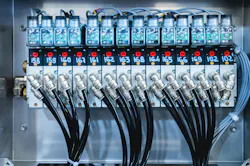
Like every industry and hardware manufacturer, there is always a push to do more but in a smaller package. Case in point, the valve manifold mentioned previously, which took up the entire width of the packaging machine. The equivalent today occupies a footprint about 8 by 12 inches.
One of the reasons for this dramatic change is the advances in how air can be moved through a valve body by way of improved materials and design. Earlier versions of a valve were made of metal, making it heavy. Today we use light-weight composites that have the same strength but don’t need thick walls. Polymers and composite materials aren’t just used in pneumatic devices, as they can be found elsewhere in automation.
The development of micro components has further enhanced the downsizing of pneumatic devices. Valves and actuators, even the sensors used to confirm position of the actuator are tiny compared to even a few years ago. Smaller packages fit in smaller spaces.
Something that has a huge impact on pneumatics is the development of smart valves where the valve can be plugged into a manifold that is connected to a fieldbus instead of discrete wiring. With this feature, a design can be standardized to a fixed number of stations on a manifold. Then plug in a variety of different kinds of valves to control specific actuators in the overall design.
The configurable manifolds can even be field-adaptable. One configuration creates zones of operation. Within a single manifold assembly, we can have a segment that has supply air all the time while another segment, fed from the opposite end of the base, can have air that is tied into a safety relay and a dump valve. The split between the two segments is an insert to block the supply port from travelling all the way through the manifold.
Get your subscription to Control Design’s daily newsletter.
Another way that manifolds can be configured is field-changeable inserts to change between tube sizes on the output. This is extremely helpful when we might size our tubing for a particular actuator only to realize that we need higher air volume—cubic feet per minute (CFM). A manifold fitting can be upsized in just a few minutes. This is far better than using an adapter to go between tube sizes because you are changing it right at the source of the air on the manifold and not in the path of the tube.
Plug-in valves with integrated solenoids provide another way that manufacturers have improved their pneumatic experience. Let’s say we plumbed up a pusher to knock products off a conveyor but learn that the pusher doesn’t quite get the product off the conveyor or doesn’t get out of the way in time for the next product to come to the station. The pluggable valve can be swapped out from a double-ended to single-ended in a minute or less. Further, since the solenoid is integrated into the valve body, changing function from energize on/energize off to energize on with automatic off/on de-energize makes function changes a breeze. We can even change from a two-way valve to a three-way valve in the same manner.
The key to the plug-in valve is the fieldbus connection. In the old way, individual wires needed to be wired from each solenoid back to a controlling device like a programmable logic controller (PLC). With the way we do things today, the valves plug into the manifold and the manifold plugs into a fieldbus converter. That converter could still be a 25-pin connector with individual wires going back to a PLC output module, but it could just as easily be an Ethernet/IP, Profibus, Modbus, DeviceNet, EtherCAT or Profinet connection to a PLC but with a lot less wiring.
Finally, making design even easier, that same fieldbus connection means that we can put items other than a pneumatic valve/solenoid on that manifold. Using the same mounting screws, the manifold can be expanded to include field-mounted I/O modules, all communicating through that same fieldbus module. Both digital and analog modules can be mounted right there in the field where the devices are mounted on the machine/process.
The bottom line for design is we don’t necessarily have to use electronic devices where a pneumatic device would still work just fine. The migration away from pneumatic was driven by a need to cut down on the energy needed to make air; but, with smaller, more efficient devices using that air, the need to totally eliminate air may not be necessary.
About the Author
 Rick Rice
Rick Rice
Contributing Editor
Rick Rice is a controls engineer at Trew Automation, a material handling manufacturer based in West Chester, Ohio. With over 38 years’ experience in the field of automation, Rice has designed and programmed everything from automotive assembly, robots, palletizing and depalletizing equipment, conveyors and forming machines for the plastics industry but most of his career has focused on OEM in the packaging machinery industry with a focus on R&D for custom applications.