Wolves in the machine: How to apply the lesson of Chesterton’s Fence to industrial safety
Key Highlights
- In an industrial setting, safety must always be prioritized over productivity, and removing machine guards or safety controls based on a lack of current knowledge poses a critical, life-altering risk.
- Any modification or removal of machine safety devices requires thorough documentation and investigation to ensure the original hazards they mitigated are either eliminated or addressed by a superior solution.
- The core principle of Chesterton's Fence is to never remove or reform an existing institutional rule, custom or safety device until you fully understand the original problem it was created to solve.
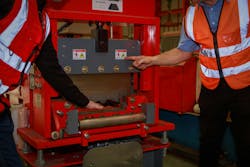
Once there was a small village at the edge of a forest. The village was surrounded by a large wooden fence that had been there as long as anyone could remember.
One day a traveler stopped for rest and a meal in the village pub. As he sat there, he noticed that he could not see the beautiful forest. The large wooden fence was blocking the view. He asked the people in the pub why the fence was there. No one knew. It had always been there. They repaired and painted the fence when it needed it, but no one had ever asked why it was there.
They called all the villagers together. None of them knew why the fence was there and agreed that if it were taken down they could all enjoy the lovely view of the forest. They started work immediately and soon the fence was gone. That evening everyone enjoyed watching the sun set over the forest and wondered why they had never before thought of this wonderful idea.
They all went to bed, very happy with their decision.
That night, as they slept, the wolves came. The wolves killed much of the village livestock that they depended on for food and milk. In the morning the villagers realized their mistake.
This is the parable of Chesterton’s Fence. It was created by early 20th century writer G.K. Chesterton to warn of the dangers of reform when the circumstances of the existing state are not understood.
In the world of automation and control, this can apply to machine processes, but more importantly to machine safety.
In most facilities there are machines that have been modified, usually by an engineer or technician. If these modifications are installed for safety purposes, they almost always follow an injury or a near miss. In time, the technical staff that made the modification, as well as the operators or supervisors that were there when the modifications were made, might have moved on to different companies. There may be no one left that knows why a guard or fence was originally put in place. To remove a safety device without thorough knowledge of why it is there causes a huge potential risk.
There are exceptions. In the event that a machine process was changed to the point where the safety device is no longer protecting anyone, it may be safe to remove. There are also designs that may not have been the best solution, in which case the device should be replaced with something better.
Even with these exceptions, the original cause of the modification and the intended purpose of a safety device should be well understood before it is removed or altered.
Get your subscription to Control Design’s daily newsletter.
To modernize the parable, we can examine another story that is certainly possible in any modern manufacturing facility.
Once there was a factory that made widgets. The machines that made the widgets were automated and ran very well, each producing 100 widgets per hour. The conveyor where the parts exited the machine had a large yellow guard covering the access into the actual machine.
One day a new operator named Tommy started and was thoroughly trained on how to safely run the machine. He ran it for two weeks and his output steadily rose to the point where he was able to produce 100 widgets per hour. During a machine setup, Tommy noticed that the large yellow guard had to be moved out of the way to allow the tooling to be changed. This extra work significantly increased the changeover time. He asked his coworkers why the guard was there. None of them knew. The guard was there when they started with the company.
Tommy suggested that, if the guard were removed, he could increase output to 110 widgets per hour. The supervisors and managers agreed, for they could not explain why the guard was there to begin with, and 10 more parts per hour would make everyone happy.
So, the guard was removed on Tommy’s machine. If it proved to increase output, then the other machines would be modified. For three weeks this machine outperformed all the other machines. It was producing 115 parts per hour, and everyone was happy.
Then one day while running the machine a widget jammed in the output conveyor in a way that no one had seen before. With the guard out of the way, Tommy realized he could easily reach into the machine to free the stuck part. That is when the wolves came.
Design or modification of machine controls demands high responsibility. Every decision should consider safety over productivity. Removable guards and fences should be interlocked into the safety controls to keep the machine from running with safety devices removed or compromised.
Safety in the workplace is the priority. Every employee deserves to go home at the end of the day in the same condition that they showed up to work in. Injuries can be life-altering.
In the words of Mr. Chesterton, "Don't ever take a fence down until you know the reason it was put up."
About the Author
 Larry Stepniak
Larry Stepniak
Flint Group
Larry Stepniak is electrical engineer at Flint Group. Contact him at [email protected].
 Leaders Logo
Leaders relevant to this article: