IMTS 2026 recap: Practical AI, accessible automation and the future of US manufacturing
Key Highlights
- IMTS 2026 showcased low-barrier, zero-CapEx financing models, teach-by-demonstration robotics and spindle-mounted tooling that allow small-to-medium manufacturers to automate without massive upfront investments.
- AI is directly embedded into shop floor operations and CAD/CAM software to instantly verify capabilities, estimate costs, automatically generate toolpaths and allow natural language machine control.
- The IMTS show floor evolved to place additive and subtractive manufacturing side-by-side, reflecting a industry-wide move toward hybrid production, digital twin simulations and streamlined software integration.
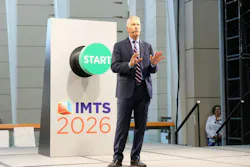
Every two years, Chicago’s McCormick Place becomes home to the western hemisphere’s largest manufacturing technology trade show, the International Manufacturing Technology Show (IMTS), hosted by the Association for Manufacturing Technology (AMT). IMTS brings together machine builders, software developers, robotics integrators and industrial leaders to showcase solutions driving productivity and sustainability (Figure 1).
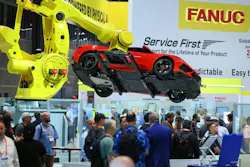
Coming off an historic surge in domestic manufacturing orders, with U.S. metalworking machinery orders exceeding $4 billion in the first seven months of 2026,this year’s event showcased an industry expanding capacity, embracing digital transformation and deploying artificial intelligence (AI).
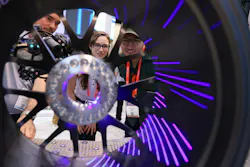
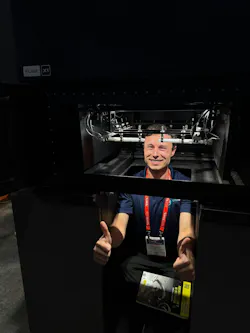
By opening morning on September 14, registration figures had already surged past 80,000, setting attendance on pace to exceed 90,000 visitors by the show's conclusion (Figure 2). Almost 1,800 companies exhibited, including 400 first-timers. More than 1 million sq ft of exhibit space covered 10 distinct technology sectors. The show welcomed participants from 113 countries, including representation from all 50 U.S. states. And the Smartforce Student Summit saw around 15,000 registrants (Figure 3).
What you missed
Our coverage of IMTS began before the event took place, and we’ll continue to add content garnered from the show.
Articles
How agentic AI turns the digital thread into action
Podcasts
IMTS 2026: MiSUMi's Dave Evans talks supply chain management and automation distribution
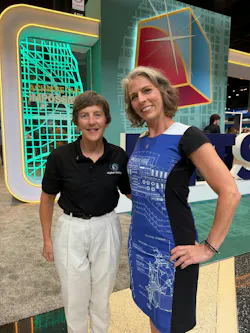
IMTS 2026 introduced strategic updates to its floor layout to reflect the convergence of complementary industrial technologies (Figure 4).
- Subtractive and Additive Fusion (South Building): For the first time, traditional metal removal and the additive manufacturing sector were integrated side-by-side in the South Building. This layout allowed engineers to explore hybrid manufacturing workflows, such as near-net additive deposition paired with five-axis CNC finishing, within a single hall.
- Expanded Software & Laser Technology (East & West Buildings): The West Building placed expanded focus on Tooling & Workholding, while the East Building housed Software, Quality Assurance and Fabricating/Laser technology sectors.
Practical AI and zero-CapEx automation
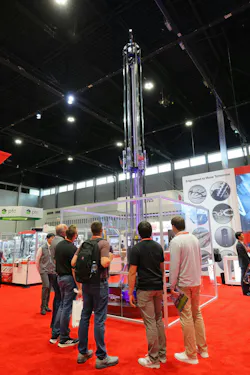
While multi-tasking CNC centers, high-speed waterjets and heavy press brakes drew continuous crowds, the overarching themes of IMTS 2026 were low-barrier automation and background AI (Figure 5).
Recognizing that fewer than 40% of small-to-medium job shops currently utilize robotics, exhibitors focused heavily on reducing adoption barriers. Automation suppliers showcased no-CapEx and low-risk financing models, treating robotic cells as operational expenses rather than massive upfront capital outlays (Figure 6).
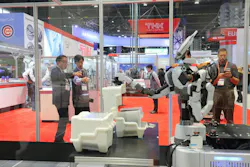
Other providers debuted teach-by-demonstration robotics. Rather than requiring complex code, operators manually guide a robot arm through a motion cycle, allowing AI vision algorithms to automatically adapt to physical part variations.
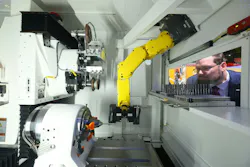
In-machine automation innovations highlighted spindle-mounted grippers and part-flipping modules. By converting standard CNC machines into self-loading cells without external robotic arms, job shops demonstrated ROI in as little as seven weeks (Figure 7).
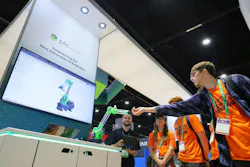
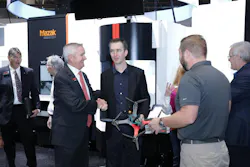
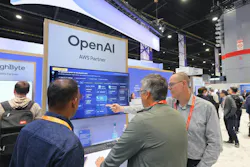
Unlike previous years where AI was treated as a futuristic buzzword, IMTS 2026 highlighted pragmatic AI tools embedded directly into CAD/CAM and quoting pipelines. Software platforms demonstrated AI engines capable of analyzing CAD files in seconds to verify shop capability, estimate tooling costs, calculate margins and automatically program toolpaths. Other systems demonstrated how machinists can adjust feeds, speeds and operation sequences using natural voice or text commands with built-in safety prompts (Figure 8).
Workforce, peer and student learning
To address ongoing skilled labor challenges, IMTS expanded its educational and community programming. The Smartforce Student Summit relocated to Level 1 of the North Building, bringing 15,000 students and educators face-to-face with advanced robotics, digital twin simulations and hands-on machining exhibits (Figure 9).
Simultaneously, the IMTS 2026 Job Shops Workshop served as an essential venue for small and mid-sized contract manufacturers. Led by small business owners and industry leaders, panel sessions tackled practical strategies for managing organizational change, integrating zero-programming automation and using cloud tools to compete against larger enterprise suppliers.
The road ahead
IMTS 2026 demonstrated that modern industrial competitiveness rests on a twin foundation: advanced physical machinery capable of precision output, paired with accessible software and robotics that maximize spindle uptime. As the manufacturing sector continues its digital evolution, attention now turns to future developments and regional open houses as builders implement the technologies that were showcased in Chicago (Figure 10).
Because IMTS operates on an even-year cycle, major machine tool builders, automation vendors and industrial software developers host their own in-house customer events, technology summits and regional open houses during odd-numbered years, such as 2027. Major IMTS exhibitors hosting notable events in 2027 include:
- DMG MORI: Pfronten Open House (February 15–26 in Pfronten, Germany — DMG MORI's flagship global event showcasing five-axis machining, automation solutions and digital twin technology. Regional Technology Days—Local solution center open houses held across the United States at the Chicago Solutions Center in Hoffman Estates, Illinois, and Technology Days in Davis, California, and Cleveland, Ohio.
- Yamazaki Mazak: Mazak Innovation Hub & Regional Technology Events — Following the launch of the Mazak Innovation Hub R&D center, Mazak will run its "Discover More With Mazak" open house series across regional centers, including Florence, Kentucky, and the Phoenix Technical Center, to feature live cutting demos on multi-tasking and five-axis machines.
- Okuma America: Okuma Winter Workshop & Technology Days — Okuma routinely hosts its annual technology events and distributor-led open houses in odd-numbered years, featuring live machining demonstrations, Okuma OSP control tech and automation integrations.
- Autodesk: Autodesk University — The flagship conference for CAD, CAM, generative design and digital manufacturing workflows.
- PTC: LiveWorx — PTC’s enterprise technology event focused on IoT, industrial CAD/CAM (Creo), Product Lifecycle Management (Windchill) and augmented reality applications.
- Siemens Digital Industries Software: Realize LIVE — Siemens' annual user conference highlighting digital thread applications, smart factory orchestration and advanced simulation solutions, such as NX, Solid Edge and Teamcenter.
- Dassault Systèmes: 3DEXPERIENCE World — Dedicated to SolidWorks, DELMIA and cloud-based manufacturing execution systems.
- Rockwell Automation: Automation Fair — Rockwell’s premier annual event showcasing industrial control systems, smart devices, safety logic and enterprise integration software.
About the Author
 Mike Bacidore
Mike Bacidore
Editor in Chief
Mike Bacidore is chief editor of Control Design and has been an integral part of the Endeavor Business Media editorial team since 2007. Previously, he was editorial director at Hughes Communications and a portfolio manager of the human resources and labor law areas at Wolters Kluwer. Bacidore holds a BA from the University of Illinois and an MBA from Lake Forest Graduate School of Management. He is an award-winning columnist, earning multiple regional and national awards from the American Society of Business Publication Editors. He may be reached at [email protected]
 Leaders Logo
Leaders relevant to this article: