A look inside the engineering transformations at Eaton and Danieli Group
Key Highlights
- True industrial transformation, as demonstrated by Eaton's factory turnaround, comes from redesigning the entire engineering-to-order value stream to eliminate the waste of people waiting for information rather than simply automating manual tasks.
- Shifting from a drawing-centric to a data-centric mindset establishes consistent, trustworthy data that flows directly into manufacturing execution systems and gives emerging technologies like AI the foundational design logic they need to audit physical work.
- Danieli Automation’s journey proves that centralizing engineering licenses and synchronizing electrical data into a single cloud-based platform is essential for maintaining global quality, enabling secure remote collaboration and successfully scaling production across international borders.
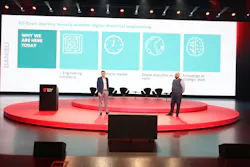
Eplan Next26 was recently held in May at Cavalluna Park in Munich, and it provided an inspiring glimpse into the future of engineering management and automation development. It brought together around 1,500 visitors from 36 nations to listen to renowned keynote speakers, attend engaging panel discussions and obtain interesting insights. It also saw the launch of Eplan Copilot and Eplan Smart Sourcing, as well as a look at the upcoming Eplan Platform 2027.
Read about Eplan CEO Sebastian Seitz's keynote address and the discussions at the Connected Industry panel, as well as an interview with Purdue University’s Dr. Grant Richards at the event.
Among the high-caliber speakers, Eplan experts, users, decision-makers and partners engaged in the event presenting on key topics regarding the future of engineering, there were also several best-practices presentations from industry professionals. Three of them, Andy Lee, operations director at Eaton ES PDSS APAC and Stefano Martinis, chief technology officer, and Jarno Calderini, vice president, engineering, at Danieli Automation, gave presentations that highlighted the importance of data consistency and the need for intelligent connections in engineering development.
Turning a troubled factory around
In his presentation, Lee talked about the transformation of the group’s Changzhou factory from one in trouble to a WEF Lighthouse facility and Eaton’s global manufacturing base for medium- and low-voltage assembly products (Figure 1). Taking over the site in 2015, the group managed to also increase capacity by more than 200% with a 39% reduction in lead time, without adding headcount. He stressed that it is not about deploying new technology; it is about redesigning the entire engineering-to-order (ETO) value stream.

For example, when it came to dealing with customers and bidding, Eaton focused on establishing a knowledge database with structured data and interoperability through standardization, using tools like Eplan. Data continuity matters, and standard processes and information reduce information handoffs, enabling first-time-right execution and significantly improved production efficiency.
In most assembly operations, people spend a lot of time waiting for information, or they're waiting for a decision. Productivity is extremely hard to replace with machine automation, which helps in a certain way, but it will never solve the core problem. The direction becomes very clear. Instead of trying to automate the people, you focus on how to remove the waste around people. That means improving the information flow so engineers, planners and operators can gather the right data just in time, reducing waiting and interpretation errors.
So the real question becomes, how can we make our engineering data truly useful? Eaton changed its mindset from drawing-centric to data-centric. Once the data is consistent, it becomes a single source of truth; it can be reused, it can be trusted. Engineering design output becomes the input for the functioning system and can be directly used by the manufacturing execution systems and even the machines on the shop floor. It isn’t about pushing people to work faster; it's about enabling first-time-right execution, using the engineering data to create real operational value.
There can be more than 500 different wires inside one cabinet; traditional visual manual inspections are very slow with a potentially high error rate, so Eaton introduced AI-based inspections supported by humanoid camera robots. However, AI alone doesn't solve the problem; it is something to compare against. The plan provides wiring logic, the connection rules and the design intent, and the AI compares what is built against the design. AI compares the reality against the design intent. Without engineering data, AI has nothing to compare against.
Digitalizing the engineering process
Martinis and Calderini talked about the group’s journey toward scalable digital electrical engineering to optimize the process of electric panels for the steel industry (Figure 2). Initially, the design of the panels was completely managed in the group’s headquarters, and the manufacturing of the panels was performed by a pool of panel makers mainly located in northern and central Italy, based on the specification, including functional requirements and outline dimensions.

Danieli’s catapult for change at that time was the high cost of digital engineering tools. The technical department was given a clear mandate: explore the market of available CAD tools to find a solution capable of supporting a more structural standardized and scalable solution. At the time, Danieli already had a CAD tool, but it was not as functional, and it was not a good solution because it was also not scalable. At that time, collaborative engineering was still just an idea, not an industrial reality.
Get your subscription to Control Design’s daily newsletter.
The group saw Eplan as an emerging standard, with the most impressive feature for the designers at that time being the schematics generator. The effort paid off during the 2008 liquidity crisis and increased market competition, as the Danieli group achieved a significant increase in terms of revenue, thanks to the design internalization. However, although the mechanical workshop increased its capacity due to new capabilities in Asia, the panel manufacturing was still concentrated in Italy, showing a clear capacity limitation.
In this context, the technical office was given a new challenge to enable panel manufacturing even without an internal office. In 2009, the group opened an office in Romania, dedicated to the development of electrical schematics. In this office, the group started creating all the macros, all the templates, everything needed to develop the schematics in-house. Another challenge that emerged in 2010 was that customers started asking for shorter delivery times to support the return on investment. The standardization that was already implemented helped, but it was not enough because engineering at that time was focused on functionality, with manufacturing efficiency and assembly logic largely unaddressed. For example, the internal design of the panels was not designed to minimize the assembly time.
This created a new goal to make everything globally uniform, from the kickoff of the engineering to panel delivery at the customer’s premises, an engineering and management objective to define clear construction standards to have the same constant global quality worldwide, leading to the adoption of Eplan 2.3, linked to enterprise resource planning (ERP) systems. The workforce in China was trained in Eplan, and, in 2018, the group also added a very large manufacturing site. The group also expanded to Alabama, with engineering and manufacturing equipment facilities, and has also established production sites in Croatia. The group implemented Eplan Pro Panel to streamline production and introduced automation for construction.
In the time after COVID, everything accelerated, shifting remote collaboration engineering from an exception to a necessity to guarantee business continuity and resilience. Complexity also increased, with more onboard intelligent devices, more programmable logic controllers (PLCs), more Wi-Fi devices, accelerated digitalization and cybersecurity emerging as a set of standards and new regulations. True quality requires system-level integration from the very early stages; the engineering department must now ensure full digital continuity of the electrical project from the machine level to the MCC, while enabling global collaboration with maximum cybersecurity and protection.
The first challenge was to bring all the information—all the data that was previously separated inside the group in various ways, in multiple files, from diverse sources—online. In 2021, the group started a strategy to create a centralized database of electrical information, taking the data that once was scattered around the group into a fully synchronized cloud database. This allowed every Danieli automation technician to work on the same data, so if something changes at the last minute, it happens in a fully tracked manner.
Meanwhile, another team had an objective to centralize all the Eplan licenses to ensure that everyone is working on the same platform and the same templates are synchronized all around the world. Recently, the group launched the Danieli Eplan Unified System to move from a situation in which every single panel had its own Eplan project and bring them all together in one single big project for each customer.
The engineering group is moving toward a digital platform where data standards and knowledge flow across discipline locations across the prototype and manufacturing lifecycle. This scales not only production capacity, but also group competence. The ability to industrialize the knowledge will be influenced massively by robotics and AI. Artificial intelligence will support engineers, amplifying their knowledge and making expertise reusable at scale. But the project needs to remain realistic, as the full replacement of workers is not yet an industrial reality.
The direction is clear: artificial intelligence and robotics will amplify human expertise. However, in the end, sustainable industrial innovation is not defined by how advanced the solution is, but by how consistently it can be deployed and operated and how it evolves.