Unlock intelligent transport systems’ value
Key Highlights
- Transitioning to intelligent transport systems requires mechanical and controls engineers to co-design machines from the start rather than using traditional sequential handoffs, drastically reducing mechanical complexity and changeover downtime.
- Optimizing dynamic motion traffic involves isolating time-critical control tasks from analytics, using local ring buffers for high-density data and equipping technicians with HMI and visual diagnostic tools rather than digging directly into PLC code.
- Machine builders can overcome initial component-cost resistance by demonstrating long-term value through smaller footprints, eliminated wear parts, reduced maintenance and dramatic throughput gains like combining multiple traditional machines into one.
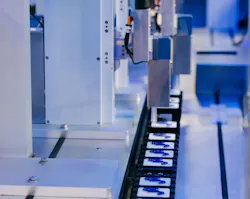
Jeff Johnson is mechatronics product manager for Beckhoff USA (Figure 1). He answered questions about transport systems.
When a machine builder transitions to independent, software-driven transport systems, how does that change the fundamental design relationship between the mechanical engineer and the controls programmer?

Jeff Johnson, mechatronics product manager, Beckhoff USA: The relationship becomes much more collaborative and iterative across the board. The controls programmer no longer has to be brought in only after the mechanical design is substantially complete. I’ve found that the most successful machine designs happen when both engineering disciplines can work together to develop the machine concept from the beginning.
A common first instinct is to apply an intelligent transport system to a traditional linear or rotary indexing layout. The stations remain evenly spaced, every product advances simultaneously, and the longest process still establishes the overall machine cycle. That may work, but it leaves many of the technology’s largest benefits unused.
The engineering team should instead begin by examining the duration of every process. How many movers does each station require? Where should products accumulate? Could a longer process be divided or duplicated across two or three stations to shorten the overall cycle? Could the mechanical design of a station be changed to reduce its processing time? Answering these questions requires input from both mechanical and controls engineering.
The mechanical engineer still owns critical decisions involving tooling, product fixturing, payloads and overall mechanics. The tooling may also need to accommodate multiple product formats. The controls engineer takes greater responsibility for mover coordination, traffic management, buffering, station synchronization and recipe-driven motion. However, this should not become a handoff of responsibility from one discipline to the other. It should be a collaboration.
Software-controlled mover spacing can also eliminate many mechanical changeover elements and avoid massive amounts of downtime. Rather than changing various parts to establish a new pitch, XTS or XPlanar can call up new mover positions and motion profiles from a recipe. In one packaging machine application, the XTS-based design eliminated about 100 mechanical parts from the infeed, including chains, flights, pushers and rotation mechanisms.
The best results come when mechanical and controls engineers treat software-defined motion control as a design tool from the outset.
As industrial motion relies increasingly on software layers, tracking algorithms and centralized data, what new skills do standard field maintenance technicians need to troubleshoot these systems?
Jeff Johnson, mechatronics product manager, Beckhoff USA: The technician’s foundational skills remain extremely important. Maintenance personnel still need to understand the machine’s operating sequences, read electrical drawings, inspect mechanical components, evaluate sensors and actuators and use tools such as a multimeter. What is changing is how quickly they can combine those skills with software- and EtherCAT-based diagnostic information.
Once a machine has completed factory acceptance testing (FAT) and operated successfully in production, an unexpected problem is often caused by a physical condition: loss of power, a damaged sensor, a loose connection, mechanical interference, product debris or a failed component. The software did not suddenly rewrite itself. The first task is to determine what changed on the machine.
Human-machine interfaces (HMIs), event logging and data acquisition tools can make that investigation far more efficient. Instead of opening PLC code and tracing through multiple layers of logic, a technician should be able to begin at the HMI. A well-designed diagnostic interface can show the affected mover, its physical location, the current machine state, associated I/O and the sequence of events leading to the stop.
TwinCAT Scope, for another example, can display real-world I/O signals alongside PLC variables and motion data. TwinCAT EventLogger provides a time-stamped history that helps identify what happened first. EtherCAT diagnostic controls can visualize the network topology and device status, while XTS-specific visualization tools can display the track, individual movers, motor modules and diagnostic conditions.
Technicians should also continue using their eyes and ears. Every machine has a heartbeat. An XTS with 50 or 100 independently moving movers will sound different from a conventional indexer in which everything moves simultaneously, but it still develops a recognizable rhythm. Changes in sound, vibration, flow or product spacing can provide valuable clues.
High-speed intelligent transport and motion systems generate massive amounts of real-time operational data. How should a system integrator architect the edge-computing or PLC infrastructure so this traffic doesn’t bottleneck the primary machine-control loops?
Jeff Johnson, mechatronics product manager, Beckhoff USA: The guiding principle is simple: Data collection must never compromise deterministic machine control. The motion and safety tasks should retain the required CPU time, network bandwidth and task priority under the worst anticipated operating conditions.
That begins with separating control from analytics logically and, where required, physically. Time-critical motion, PLC and machine safety functions should run in deterministic real-time tasks with defined priorities and adequate processing bandwidth. Analytics, database communication, dashboards and cloud connectivity should operate on separate CPU cores or in lower-priority tasks when priorities need to be set.
The next step is to decide what data truly needs to leave the controller. Sending every variable, bit and byte continuously is rarely useful. Some values only need to be transmitted at startup, after a recipe change or when they cross a threshold. Others can be aggregated into cycle times, averages, counts or condition indicators in an edge computer. Critical production data, faults and other urgent events should receive priority rather than competing with a constant stream of low-value data.
There are cases in which full-resolution data is valuable, particularly for intermittent troubleshooting. A practical approach is to record this data locally in a time-synchronized ring buffer. The system continuously retains a defined period—perhaps the preceding hour—and saves that buffer when a fault or trigger condition occurs. This provides detailed before-and-after information without continuously flooding a database or cloud service.
TwinCAT Analytics Logger can acquire process-image and PLC data cycle-synchronously, store it locally on a hard drive or transmit selected data through MQTT. The information can then be analyzed locally, on another computer or in a cloud environment. Once engineers identify the variables and calculations that deliver useful insights, they can reduce the ongoing data stream to the essential values. A message broker also helps decouple the machine from downstream applications. The controller can publish approved data to the broker, while authorized systems subscribe to it without querying the real-time controller directly.
For difficult intermittent problems, synchronized machine vision can add important context. Aligning images with real-world I/O, PLC states and motion data can reveal not just that a fault occurred, but what was physically happening at that moment. There’s also an available Event Video Playback add-on feature that provides an easy-to-use video review of events/alarms as logged events directly from TwinCAT HMI Event Viewer.
With advanced transport systems making manufacturing processes highly dynamic and recipe-driven, how should the HMI evolve to help operators visualize complex routing, bottlenecks and system errors in real time?
Jeff Johnson, mechatronics product manager, Beckhoff USA: The HMI should evolve from a collection of buttons and alarm lists into a live operational model of the machine. With products moving on dynamic intelligent transport systems, a static screen cannot adequately explain what the system is doing or why.
At the highest level, operators should see the actual transport layout, the location and status of each mover, active product recipes, station conditions and the direction of product flow. Use of color and animation can highlight blocked movers, accumulating queues or stations operating outside their target cycle times. Rather than displaying every available data point, the overview should direct attention to exceptions.
The next level should provide production context. Operators need to see buffer utilization, actual versus target dwell time, station throughput and the distribution of products among parallel processes. If a particular station becomes the constraint, the HMI should make that visible before it stops the machine. On an XPlanar system, the display should also show active routes, unavailable tiles and rerouting decisions (Figure 2).
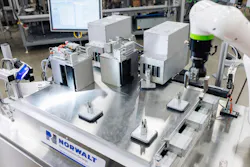
Alarms need similar context. A useful message should identify the affected mover or product, its location, the current recipe, the last successfully completed step and the event that initiated the stop. Simply displaying an error code or presenting 20 secondary faults caused by one sensor failure forces the operator to reconstruct the sequence manually and waste valuable time when a machine stops.
Get your subscription to Control Design’s daily newsletter.
Visualization should also be role-based. Operators need clear status information and guided recovery steps. Maintenance personnel need drill-down access to I/O states, network diagnostics, event histories, motion traces and component-level information. Engineers may need deeper access to sequence states, recipe parameters and synchronized historical data.
The HMI must also adapt as the machine changes. When a recipe modifies mover pitch, activates parallel stations or selects a different route, the visualization should update automatically instead of relying on a separately maintained static drawing. With XTS HMI Control software, for example, the HMI visualization can be generated from the existing track configuration and linked to the relevant mover parameters.
Ultimately, the HMI should answer four questions immediately: What is the problem? Where is it? What caused it? What should the operator do next? When the answers are presented clearly, it makes the machine much easier to operate and maintain.
Intelligent, software-configurable motion hardware has a higher upfront component cost than traditional hardware, such as belts, chains and indexing tables. What advice do you have for a machine builder trying to justify that higher bill of materials (BOM) to a procurement-focused customer?
Jeff Johnson, mechatronics product manager, Beckhoff USA: The first step is to expand the conversation beyond the component-level BOM. The upfront purchase price is the easiest number to see, but it rarely represents the lowest overall cost of designing, building, installing and operating the machine. Machine builders should present a side-by-side total-cost-of-ownership (TCO) analysis that includes mechanical and electrical design, programming, fabrication, required floor space, commissioning, changeovers, maintenance, reliability, throughput and expected equipment life.
As discussed, an intelligent transport system can dramatically reduce the amount of required machine components. Intelligently controlled and independent movers, moving buffers and parallel processing stations can increase throughput within a much smaller footprint. In a L’Oreal cosmetics filling machine in France, for example, the company leveraged XTS to combine the functionality of five traditional filling machines in a single production line.
The reduction in mechanical complexity should be quantified and assigned a value. Chains, belts, gears, indexers, timing screws, mechanical linkages and change parts all require engineering, sourcing, assembly, alignment and documentation. They also create numerous potential points of failure and spare-parts requirements. Replacing even some of that mechanical complexity with tested software functions can seriously reduce engineering hours and shorten commissioning, while making future machine variants easier to develop.
Then consider the value of flexibility. If a conventional machine requires mechanical change parts, extended downtime or a second production line to manufacture in a new format, that initial price difference disappears quickly. Procurement may focus on today’s BOM, but operations will care about the cost of every future product change and the impact on the plant floor.
Maintenance should be evaluated realistically as well. Intelligent transport systems are low-maintenance, not maintenance-free. Both XTS and XPlanar eliminate many conventional wear components and lubrication points. XPlanar is virtually free of mechanical wear and tear when looking directly at the system itself. The main considerations would be any vibrations or shock presented by any equipment installed around an XPlanar system.
And depending on the selected XTS mover and guidance system, payload, speed, acceleration, and duty cycle, that transport system’s lifecycle calculations can extend to more than 100,000 km in terms of mover roller life. This could represent five years or more of production before a replacement (Figure 3).
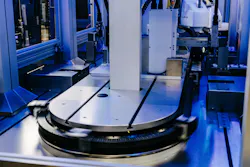
XTS guide rails typically outlast individual mover roller sets. As an application-specific rule of thumb, a rail may remain in service through three roller replacement cycles. A severe machine jam could require roller inspection or tension adjustment, but that is an abnormal event rather than a routine maintenance task. The machine builder should use the actual operating conditions to calculate expected inspection and replacement intervals rather than making a blanket service-life claim based on any individual component or subsystem.
Most importantly, you should put the benefits into the end-user customer’s financial language: cost per sellable unit, square feet of production space, minutes of changeover time, hours of avoided maintenance, expected uptime and the estimated value of additional throughput per machine. Bring operations, engineering and maintenance into the evaluation alongside procurement so everyone understands the overall value and TCO. When the customer compares complete machine performance and lifecycle cost, not simply the lines of the BOM, any higher initial component cost becomes a much easier investment to justify.
Tell us about one of your company’s state-of-the-art transport-system products.
Jeff Johnson, mechatronics product manager, Beckhoff USA: Beckhoff offers two intelligent transport systems: the XTS and XPlanar systems. Both replace rigid, mechanically linked product flow with independently controlled movers, but they approach the application from different dimensions, literally.
XTS is a linear transport system in which wireless, magnetically driven movers travel along a modular track with numerous options for straight, curved and angled segments. Its five basic elements—motor modules, guide rails, movers, an industrial PC running standard TwinCAT automation software—provide a compact and highly flexible alternative to conventional conveyors, indexing systems, chains and mechanical linkages. Each XTS mover functions as an individual servo axis with its own position, velocity and motion profile.
XPlanar extends this concept into new dimensions. Its movers, also wireless, levitate above a freely configurable surface of motor tiles, enabling contactless product transport with up to six degrees of freedom. The basic system requires just four component types: magnetic motor tiles, movers, connection cables and, again, an industrial PC running TwinCAT. XPlanar movers can travel in x and y coordinates, rotate continuously and perform controlled lifting, tilting and oscillating motions. This can allow the transport system itself to perform positioning or handling functions that would otherwise require additional mechanical axes or robots.
With both XTS and XPlanar, the respective movers can operate independently, form synchronized groups or coordinate with robots, vision systems and other external equipment. Because there is no fixed station-to-station pitch, designers can place process stations exactly where they make the most sense and easily adjust mover spacing and path planning in software.
This enables moving buffers, multi-up processing stations and dynamic routing. If one process requires more time, the machine can accumulate products ahead of that station or distribute them among multiple identical stations. Faster processes no longer need to sit idle while waiting for the slowest operation. That is the real value of intelligent transport: It does not simply move products faster; it allows engineers to rethink the entire architecture of the machine.
About the Author
 Mike Bacidore
Mike Bacidore
Editor in Chief
Mike Bacidore is chief editor of Control Design and has been an integral part of the Endeavor Business Media editorial team since 2007. Previously, he was editorial director at Hughes Communications and a portfolio manager of the human resources and labor law areas at Wolters Kluwer. Bacidore holds a BA from the University of Illinois and an MBA from Lake Forest Graduate School of Management. He is an award-winning columnist, earning multiple regional and national awards from the American Society of Business Publication Editors. He may be reached at [email protected]
 Leaders Logo
Leaders relevant to this article: