Why silent failures in machine safety devices require periodic testing
Key Highlights
- Mechanical jams, welded switch contacts or intentional tampering can leave a safeguard non-functional without any visible warning signs.
- You must actively trigger safety gates, light curtains and e-stops under normal operating conditions, individually, even when wired in series or parallel, to confirm they stop the machine and prevent restarts until reset.
- Aligning documented functional tests with planned maintenance takes minimal time compared to the life-altering cost of a lost-time injury.

A stone watchtower stood silhouetted on the ridge above the village. For longer than anyone in the village could remember, sentries took their shift in the tower ready to light the signal fire if raiders were spotted. This fire would be seen by another watchman, who would light his fire continuing a chain of signals all the way to the village.
This would offer the villagers plenty of time to prepare for a coming invasion. Raiders had not come for a long time, and thus the fires were not lit.
One day, before the dawn, the sentry saw movement. A raiding party was headed straight toward the village. Quickly he moved to light the signal fire, but the wood had long since rotted and would not light. The raiders rode quietly past the series of unaware watchmen and reached the village before anyone could prepare.
The purpose of protection
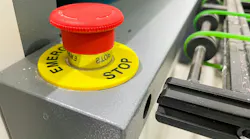
A safety device has one job, and it may go years without being asked to do it. It is there to protect anyone working on or around the machine. This could be a safety gate to keep someone from accessing moving parts, an emergency-stop (e-stop) button to halt the machine suddenly to prevent harm, a light curtain to stop the machine when hands reach toward a hazard, or many other safety mechanisms.
These devices must work when needed. Safety in the workplace is the priority. Every employee deserves to go home at the end of the day in the same condition that they showed up to work in.
Many devices will fail silently. An actuator for a safety gate could become misaligned and jam into the mechanism. An emergency-stop button could be broken in a manner that would prevent it from being pressed. Some failures cannot be seen by looking at the device, such as a switch whose contacts stay closed when the gate opens. Depending on the circuit design and control programming this may not be caught by the safety relay or controller. Operators and maintenance personnel should report or correct what they notice, but it is not always easy to see a pending malfunction. An interlock that is a nuisance could also be tampered with or removed in order to increase production.
Get your subscription to Control Design’s daily newsletter.
Periodic testing and documentation
Unless these mechanisms are periodically tested, it is unknown if they will perform the needed function when it is needed. The frequency of testing depends on many factors such as the risk assessment, the manufacturer’s recommendations and the device type. Some may call for a daily check and others less frequent. It is important that the devices are not merely inspected but rather tested under normal machine operating conditions. Open the safety gate or break the plane of the light curtain with the manufacturer’s recommended test part and ensure that the machine stops. Also test that the machine will not restart until gates are closed and everything is properly reset. Press each emergency stop and confirm that the machine stops and stays stopped until reset. If there are multiple devices in series or in parallel make sure that each one is tested, because a fault in one can be hidden by the others. The testing should always be performed by qualified, trained personnel following a written procedure.
If it does not pass the safety test, lock the machine out until repairs are made. Record the date, time, tester and results of tests on each device. Note any repairs or replacements that are made.
These tests do require a loss of production time and the time of technical personnel. For example, if a line has 14 guarded openings, tested quarterly at about 10 minutes each:
14 guards × 4 tests × 10 minutes = 560 minutes,
or about 9 hours of production and technician time per year.
This lost production and time can be minimized by scheduling the testing to coincide with planned maintenance time.
Compare the cost of this exercise with the cost of one lost-time incident. Remember the cost to the affected worker can be life-altering.
The sentry in the watchtower should be required to periodically light the fire to ensure it will work when needed, and every watchman in the chain should respond. Pick one machine this week, test every safety device on it, and write down the results. It takes little effort, but it could save the village.
Read Larry Stepniak’s companion piece, Wolves in the machine: How to apply the lesson of Chesterton’s Fence to industrial safety.
About the Author
 Larry Stepniak
Flint Group
Larry Stepniak is electrical engineer at Flint Group. Contact him at [email protected].

 Leaders Logo
Leaders relevant to this article: