When does a custom printed circuit board make sense for control?
Key Highlights
- Custom PCBs are best suited for mass-produced, lower-complexity and cost-sensitive machines that require low unit costs, high industrial durability and minimal end-user maintenance.
- To address a growing industry-wide shortage of qualified electronics hardware designers, Siemens and Arizona State University developed a targeted, 40-hour online microcredential program covering end-to-end PCB design workflows.
- While standard component selection heavily favors reliability and early-stage integration over low price, more than 90% of PCB engineers now leverage AI tools primarily to accelerate design iterations despite remaining concerns over data security and accuracy.
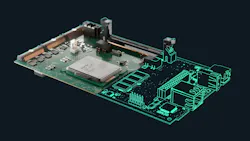
While machine builders and system integrators customarily use programmable logic controllers (PLCs), industrial PCs (IPCs) and DIN-rail modules for machine control, they sometimes utilize custom printed circuit boards (PCBs) when necessary.

"I have a client right now that uses custom PCBs instead of classic PLC controls for their equipment," says Heath Stephens, digitalization leader at Hargrove Controls + Automation, a CSIA-certified system integration and engineering consultant headquartered in Mobile, Alabama (Figure 1). "PCBs usually only make sense for equipment units that are designed to be replicated and repeated. The decision comes down to a few factors like how many units are going to be produced, how complex the unit is to be controlled, how cost-sensitive is the unit and how will the unit be supported."
What scenarios are suitable for the use of printed circuit boards? "PCBs may be appropriate where you intend to produce many very similar units, where the overall control complexity/size is fairly small, where the unit cost is low enough that the control-system spend makes a meaningful impact to the overall unit cost and where the end user is not expected to do any control-system maintenance," explains Stephens.
"The downsides of PCBs are the initial design costs and the ongoing support knowledge that will need to be maintained in-house," he adds.

"For controls processing, I need circuit boards that are replaceable, so I can get spares," says Tobey Strauch, a controls engineer and project manager with more than 20 years of experience with automation (Figure 2). "Then it's important that they use components that are hardy enough to meet the environments that they may be placed in—for example, heavy-duty, industrial-rated, which means the coatings can handle heat and debris and chemicals better than non-rated ones."
Where have all the PCBs gone?
Besides the initial design costs and ongoing support knowledge needed, another downside of the PCB is its availability.
To remedy this, Arizona State University (ASU) has worked with Siemens to develop an online microcredential program in printed circuit board (PCB) design called PCB Design Fundamentals: From Discovery to Production, which offers a direct path to an in-demand skillset in the electronics industry.
The electronics industry is scaling, driven by growth in artificial intelligence (AI) infrastructure, and the pipeline of qualified PCB designers needs to keep pace: employers are searching for talent fluent in modern electronic design automation (EDA) workflows. This program was built specifically to close the workforce readiness gap between moving a board design from schematic to production-ready handoff.
"PCB design is an applied skillset that sits at the intersection of engineering knowledge and real production workflows," says Dora Smith, senior director, future workforce strategy at Siemens Digital Industries Software. "This program gives learners the hands-on experience they need to contribute to real projects and gives employers confidence that the candidates with a Siemens microcredential are ready to do the work."
“At ASU, we're focused on creating learning experiences that connect engineering fundamentals with the skills employers need today,” says Kyle Squires, senior vice provost of engineering, computing and technology and dean of the Ira A. Fulton Schools of Engineering at Arizona State University. “By combining the expertise of our faculty with Siemens’ technology and industry insights, this program helps learners develop the practical knowledge needed to contribute to electronics design projects and advance into high-impact engineering roles.”
Delivered online and self-paced, the microcredential program is 40 hours comprising four courses that cover PCB design fundamentals and best practices, schematic design and component selection, multi-layer layout and advanced routing, design for manufacturability (DFM) and production handoff. Learners work with Siemens’ Xpedition software for PCB design, which is used across aerospace and automotive sectors.
With no prerequisites required, the program is accessible to undergraduate engineering students, technicians, career changers and engineers from adjacent disciplines seeking to add hardware design capability to their skillset.
Get your subscription to Control Design’s daily newsletter.
"The electronics industry is facing a real and growing shortage of engineers who can move a board design through every stage, from concept to a manufacturable product," said AJ Incorvaia, senior vice president of electronic board systems, Siemens Digital Industries Software. "The effects of this situation are already impacting engineering teams, who are facing greater pressure and tighter timelines with fewer people with the hands-on experience to close the gap. This program addresses that directly, giving learners the applied skills they need."
Upon completing the program, learners earn a microcredential from Siemens and a professional certificate from ASU. The microcredential badge can be displayed on LinkedIn and other professional platforms, making the achievement of applied knowledge and skills visible to recruiters and hiring managers. Learners who complete the microcredential are also invited to join the Siemens Talent Directory, which Siemens and its commercial customers can use to identify candidates with specific skillsets.
Secret sauce ingredients
Weidmuller USA released the results of a national survey about printed-circuit-board (PCB) design it commissioned EETech Research to conduct in April-May. According to the survey of 400 engineers in North America, which sought to understand how they design PCBs, evaluate components and use emerging tools such as AI in their workflows, nearly 80% of respondents placed the highest value on a product’s reliability when selecting components. Component performance also topped the list of reasons why the engineers would make a product switch.
More than nine in 10 of the engineers participating in the survey have used AI-based tools in their PCB design workflows. Three-quarters of respondents viewed AI tools as a productivity and acceleration layer within existing workflows for increased efficiency and faster design iteration.
The responding engineers also provided insights on their decision-making during the PCB design process, with almost half saying that component selections for a new PCB design are finalized during the early concept phase or in the schematic design phase.
Some key findings from the survey include:
- 79% of respondents said “high reliability and durability” are the most important features for device connectivity, compared to only 22% saying price is most important in their decision-making.
- Top factors for trying a new product or component in the past 2-3 years are better performance, cost savings and improved reliability.
- 43% of respondents said most component selections for a new PCB design are finalized either in the early concept/architecture phase or in the schematic design phase, and 26% said component selection is usually iterative across multiple stages.
- 91% have used AI-based tools in their PCB design workflows, with faster design iterations being seen currently as the primary value of AI.
When asked what they “wish existed” in AI tools, the study requested write-in answers which reveal that engineers see real and persistent gaps in the promise and reality of AI for PCB design, including lack of real-time error detection and fully autonomous text to the PCB.
“This new research reinforces the importance that engineers place on improvement in performance, reliability, workflow efficiency and supply resilience, especially when these benefits are integrated directly into the PCB design process,” said John Froustet, senior director, product portfolio management, at Weidmuller USA. “While AI tools are increasingly looked to for speed and accuracy, many questions around data security and accuracy of results still linger.”
About the Author
 Mike Bacidore
Mike Bacidore
Editor in Chief
Mike Bacidore is chief editor of Control Design and has been an integral part of the Endeavor Business Media editorial team since 2007. Previously, he was editorial director at Hughes Communications and a portfolio manager of the human resources and labor law areas at Wolters Kluwer. Bacidore holds a BA from the University of Illinois and an MBA from Lake Forest Graduate School of Management. He is an award-winning columnist, earning multiple regional and national awards from the American Society of Business Publication Editors. He may be reached at [email protected]
 Leaders Logo
Leaders relevant to this article: